
Every time you slide behind the wheel, the air that fills your car’s cabin comes straight from the filter, influencing everything from breathability to the longevity of your HVAC system. A high‑quality cabin air filter traps pollen, dust, and harmful pollutants, keeping allergies at bay and protecting delicate electronics from grime. Yet with countless brands promising “clean air,” it’s easy to feel overwhelmed when selecting the right one for your vehicle and budget. In this post we’ve tested and compared the market’s top performers, narrowing the field to the six best cabin‑air‑filter brands that deliver real, measurable benefits. Read on to discover which filters earned our seal of approval.
6 Top Cabin Air Filter Brands You’ll Love
We’ve tested countless options, and these six filters consistently deliver superior air quality, durability, and easy installation for any vehicle.
6. CARORY Cabin Air Filter for Toyota & Lexus

The CARORY Cabin Air Filter with Activated Carbon is engineered to keep the interior of your Toyota, Lexus, Subaru, or Mazda fresh and free from pollutants. Designed as a direct‑fit replacement, it matches a wide range of model years—from 2016 through 2024—including popular Toyota models such as Camry, Corolla, RAV4, Prius, Highlander, and Sienna, as well as Lexus ES, NX, RX, UX, and TX families, Subaru Outback and Crosstrek, and Mazda CX‑9. The filter meets OEM reference numbers (e.g., 87139‑0E040, 97139‑58010, 72880‑FL00A, TK48‑61‑J6X) and has been cross‑checked for exact fit, even for Japan‑built vehicles (VIN starting with “J”).
Key features
– Activated carbon layer captures odors, smoke, and harmful gases.
– High‑efficiency particulate media traps dust, pollen, and fine particles.
– Comprehensive fit list covering over 30 vehicle models and multiple trim levels.
– OEM‑approved reference numbers guarantee a seamless, bolt‑free installation.
Pros
- Improved cabin air quality – the dual‑stage filtration neutralizes odors while blocking allergens.
- Exact fit for a wide range of models – no modifications or extra hardware needed.
- Long‑lasting performance – activated carbon remains effective throughout the recommended service interval.
Cons
- Japan‑only fit for certain models – vehicles without a “J” VIN prefix are not compatible.
- May require periodic replacement – to maintain optimal filtration, the filter should be swapped at the manufacturer‑suggested interval.
5. BOSCH 6081C HEPA Cabin Air Filter
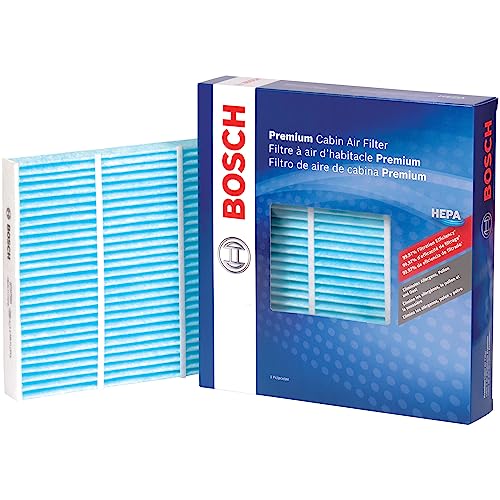
The Bosch 6081C HEPA Cabin Air Filter delivers the cleanest interior air possible for you and your family. Engineered to meet ISO 29463‑3:2011 HEPA standards, it captures 99.97 % of particles down to 0.3 µm, thanks to a melt‑blown electrostatic layer combined with a dense media and an extra static cotton layer for higher capacity. Structural ribs reinforce the filter’s shape, preserving integrity and performance throughout its service life. Bosch’s design avoids added chemical odor neutralizers, providing pure, chemical‑free airflow. Replace the filter at least once every 12 months—or 12 K miles—to maintain optimal ventilation. This model fits a wide range of Ford Super Duty trucks and the Lincoln Navigator (2018‑23 Expedition, 2015‑23 F‑150, 2022‑23 F‑150 Lightning, 2017‑22 F‑250/350/450/550 Super Duty, 2019‑23 Navigator). Verify trim‑level compatibility with the fit checker before purchase.
Pros
- Medical‑grade filtration – 99.97 % efficiency at 0.3 µm meets true HEPA standards.
- Durable construction – Ribs and layered media keep the filter stable and effective for its full lifespan.
- Chemical‑free air – No added odor neutralizers, ensuring only clean, natural cabin air.
Cons
- Fit may vary by trim – Some vehicle trims require verification to ensure proper installation.
- Annual replacement needed – To sustain peak performance, the filter should be changed every 12 months or 12 K miles.
4. BOSCH 6055C HEPA Cabin Air Filter
Bosch 6055C HEPA Cabin Air Filter delivers the cleanest breathing environment for you and your passengers. Engineered to meet ISO 29463‑3:2011 HEPA standards, it captures 99.97 % of particles down to 0.3 µm, thanks to a melt‑blown electrostatic layer, dense media, and an additional static cotton layer for higher capacity. Structural ribs keep the filter stable throughout its service life, while the filter’s design omits chemical odor neutralizers, providing pure, chemical‑free air. Replace it every 12 months (or 12 K mi) to maintain optimal performance. The filter fits a wide range of models—including select Lexus (ES, GS, GX, IS, LS, RX), Subaru (Legacy, Outback), and Toyota (4Runner, Camry, Corolla, Highlander, Prius, RAV4, Sequoia, Sienna, Tundra, and many more)—but always verify fitment with the vehicle’s trim level.
Key Features
– HEPA‑grade filtration (99.97 % at 0.3 µm)
– Melt‑blown electrostatic + static cotton layers for superior particle capture
– Structural ribs for lasting filter integrity
– Chemical‑free air purification (no added odor neutralizers)
– Broad vehicle compatibility (see fit checker for exact models)
Pros
- Exceptional filtration – removes allergens, dust, pollen, and smoke particles for healthier cabin air.
- Long‑lasting stability – ribs and dense media keep the filter intact even under high‑flow conditions.
- Chemical‑free freshness – no artificial scents, just pure air for occupants with sensitivities.
Cons
- No odor‑neutralizing additive – if you prefer a scented cabin, you’ll need a separate product.
- Fit may vary by trim – always double‑check the specific vehicle configuration before purchase.
3. EPAuto CP285 Cabin Air Filter

The EPAuto CP285 (CF10285) Premium Cabin Air Filter with Activated Carbon is engineered to keep the interior of your vehicle breathing clean, fresh air. Featuring a high‑efficiency blend of soda and activated carbon, it neutralizes odors, pollen, and harmful pollutants while improving HVAC performance. Designed as a direct replacement for Toyota genuine part numbers 87139‑… and compatible with a wide range of models—from the 2010‑2024 Toyota 4Runner to the 2025 Jaguar F‑Pace and Land Rover Range Rover line—this filter fits seamlessly into your car’s existing housing. Installation is a breeze; just drop it in and enjoy a cleaner cabin without any special tools. EPAuto recommends swapping the filter every 12 months or 12,000 miles to maintain optimal airflow and odor‑control.
Pros
- Broad vehicle compatibility – covers most Toyota, Lexus, Subaru, Jaguar, Land Rover, Scion, Pontiac, and Ford models listed.
- Activated carbon layer – actively absorbs odors, VOCs, and smoke for a noticeably fresher interior.
- Enhanced HVAC efficiency – cleaner airflow reduces strain on the climate system, potentially improving fuel economy.
Cons
- Replacement frequency – to keep performance at its peak, the filter should be changed annually or every 12,000 miles, which adds a recurring maintenance cost.
- Fit precision – while it matches many OEM part numbers, older or heavily modified vehicles may require a double‑check of dimensions before purchase.
2. BOSCH 6092C HEPA Cabin Air Filter
The Bosch 6092C HEPA Cabin Air Filter delivers the cleanest breathing environment for you and your passengers. Engineered to meet ISO 29463‑3:2011 HEPA standards, it captures 99.97 % of particles down to 0.3 µm, thanks to a melt‑blown electrostatic layer combined with a dense media and an extra static‑cotton layer for higher capacity. Structural ribs reinforce the filter’s shape, ensuring stability and consistent performance throughout its service life. Bosch’s design omits chemical odor neutralizers, providing pure, chemical‑free air—ideal for those with respiratory sensitivities. Replace the filter every 12 months (or 12 K mi) to maintain optimal airflow and cabin comfort.
Compatible with a wide range of models, including select Subaru (2020‑21 Ascent, 2018‑21 Croscrosstrek, 2017‑20 Impreza, 2020‑21 Legacy, 2020‑22 Outback) and Toyota vehicles (2018‑20 C‑HR, 2019‑20 Corolla, 2016‑21 Prius, 2019‑21 Prius AWD‑e, 2017‑21 Prius Prime, 2019‑20 RAV4, 2021 RAV4 Prime, 2021 Venza). Verify trim‑level fitment before purchase.
Pros
- HEPA‑grade filtration (99.97 % at 0.3 µm) – traps pollen, dust, smoke, and fine pollutants.
- Robust construction – melt‑blown layer + static cotton + structural ribs for lasting performance.
- Chemical‑free air – no added odor neutralizers, preserving natural cabin scent.
Cons
- No built‑in odor neutralizer – may require a separate deodorizing solution for strong smells.
- Fitment may vary by trim – double‑check vehicle specifics to avoid incompatibility.
1. BOSCH 6091C HEPA Cabin Air Filter
Bosch 6091C HEPA Cabin Air Filter delivers the clean‑air performance you expect from a premium brand. Engineered to meet ISO 29463‑3:2011 HEPA standards, the filter captures 99.97 % of particles as small as 0.3 µm, removing dust, pollen, mold spores and even fine‑tuned pollutants from the cabin. A melt‑blown electrostatic layer teamed with a dense media and an added static‑cotton layer gives the filter extra trapping capacity, while structural ribs keep the media flat and stable for a full‑life service interval. Bosch’s design skips chemical odor neutralizers, providing pure, odor‑free air that’s gentle on respiratory health. Replace it every 12 months or 12 K miles for optimal performance.
The filter fits a broad range of GM models—including select Buick Enclave & Encore GX, Cadillac XT4/XT5, Chevrolet Camaro, Cruze, Impala, Malibu, Silverado, Traverse, and many GMC trucks and SUVs—though trim‑level variations may affect fitment, so verify with the online fit checker.
Pros
- HEPA‑grade filtration (99.97 % at 0.3 µm) – unparalleled protection for you and your family.
- Durable, rib‑reinforced media – maintains shape and efficiency throughout its service life.
- Chemical‑free, odor‑neutral operation – delivers truly fresh cabin air without added scents.
Cons
- No built‑in odor neutralizer – if you prefer a scented cabin, you’ll need a separate product.
- Fit may vary by trim level – double‑check compatibility before purchase.
Buying Guide
When choosing the best cabin air filter brand, focus on filtration efficiency, fit compatibility, and long‑term performance to keep your vehicle’s interior air clean and fresh.
- Filtration efficiency: Look for HEPA‑grade or electrostatic media that captures at least 99% of particles down to 0.3 microns, including pollen, dust, and odors.
- Vehicle fit: Verify the filter’s dimensions and mounting style match your make and model to avoid leaks or improper airflow.
- Durability and lifespan: Select filters rated for 12‑15 months of service under typical driving conditions, with robust frames that resist tearing.
- Value and cost: Compare price per filter against its performance rating; premium brands may cost more but often deliver superior air quality and fewer replacements.
- Customer reviews and warranty: Check real‑world feedback and choose brands that offer at least a 12‑month warranty for peace of mind.
By weighing these factors—efficiency, fit, durability, price, and proven reliability—you can select a cabin air filter that protects your health and preserves your vehicle’s HVAC system.
Frequently Asked Questions
Which cabin air filter brand offers the best overall performance for most vehicles?
Answer: Fram consistently ranks at the top for overall performance. Their Ultra Synthetic blend combines high-efficiency filtration (up to 99% of dust, pollen, and mold spores) with a low pressure drop, which helps maintain engine efficiency while keeping the cabin air clean.
Are there any premium cabin air filter brands worth the extra cost?
Answer: Yes. Mann‑Filter and Bosch offer premium options with activated carbon layers that actively reduce odors, VOCs, and harmful gases. These filters are especially beneficial for drivers in urban areas or those with allergies, though they tend to be 20‑30% more expensive than standard models.
How often should I replace my cabin air filter, and does the brand affect this interval?
Answer: Most manufacturers recommend replacement every 12,000–15,000 miles (or once a year), but high‑efficiency or carbon‑infused filters (e.g., from Mann‑Filter or Bosch) may last up to 20,000 miles under normal driving conditions. Always check the specific product’s guidelines and inspect the filter during routine service; a visibly dirty filter should be swapped out sooner regardless of brand.
Conclusion
Choosing the right cabin air filter is more than a simple maintenance task; it directly impacts the comfort, health, and longevity of your vehicle’s interior. The best options combine high filtration efficiency with low airflow resistance, ensuring clean air without sacrificing performance. Look for filters that balance durability and cost, offer easy installation, and come from brands with a reputation for consistent quality control. Regular replacement according to the manufacturer’s schedule maximizes these benefits and prevents premature wear on HVAC components. By prioritizing these criteria, drivers can enjoy fresher rides, reduced allergens, and a healthier driving environment for years to come.