
The 4-Port USB-C Car Charger is the top pick for most buyers because four ports let passengers charge at once. For shoppers seeking the best premium car charger adapter, this compact charger offers a practical upgrade for busy cars without crowding the 12-volt socket.
This guide is for drivers who need dependable charging for phones, tablets, cameras, or handheld consoles during daily commutes and road trips. The key factors are total charging output, USB-C power delivery, port layout, and the adapter’s size inside the vehicle. A powerful unit is useful, but it should not block nearby controls or feel loose in the socket. The 7 picks below are ranked with clear reasons and honest drawbacks for each, so you can match the charger to your devices, passengers, and driving habits.
Quick Comparison
| # | Product | Best For | Price | |
|---|---|---|---|---|
| 1 | 4-Port USB-C Car Charger | Families Charging Multiple Devices | ~$13 | View → |
| 2 | LISEN USB-C Car Charger, 2-Pack | Backup Charger For Two Cars | ~$10 | View → |
| 3 | 3-Port USB-C/USB-A Car Charger Adapter | Mixed USB-C And USB-A Devices | ~$10 | View → |
| 4 | LISEN 90W USB-C Car Charger | High-Power Laptop Charging On Road | ~$10 | View → |
| 5 | Anker 323 USB-C Car Charger | Compact Everyday Phone Charging | ~$15 | View → |
| 6 | 67W 3-Port USB-C Car Charger | Road Trips With Several Devices | ~$10 | View → |
| 7 | LISEN 90W Car Charger | Fast Charging For Work Commutes | ~$20 | View → |
7 Premium Car Chargers Worth Buying
These premium car chargers are ranked from solid options to our top pick, with key features and trade-offs compared along the way.
7. LISEN 90W Car Charger

Best for: Families sharing one car socket
The LISEN 90W car charger plugs into a standard 12V cigarette-lighter socket and can power three devices at once. It includes a built-in USB-C cable rated at 45W, plus two additional charging ports. The cable extends up to 60 inches, which gives rear-seat passengers enough reach for phones or tablets. A soft halo light helps locate the charger after dark without a bright screen-like glow.
Its main advantage is flexibility during shared trips. The built-in cable supports newer USB-C iPhones, including the iPhone 15, 16, and 17 lines, along with recent Samsung phones. Older iPhones need their original Lightning cable through one of the other ports. LISEN claims charging from 0% to 80% in 30 minutes, though actual speed depends on the device, cable, and power split. Safety certifications listed include UL, CE, FCC, and RoHS. At around $20, it offers useful capacity for commuters and families.
Pros
- Three-device charging helps passengers share one 12V socket.
- The 60-inch retractable cable reaches rear seats and coils away afterward.
- Built-in safeguards cover overcurrent, overvoltage, overheating, overload, and short circuits.
Cons
- The built-in cable uses USB-C, so older iPhones require a separate Lightning cable.
- Total power divides across connected devices, so three devices may charge slower than one.
6. 67W 3-Port USB-C Car Charger

Best for: Drivers charging multiple phones
This compact car adapter provides three charging ports: one USB-C and two USB-A. Its rated output reaches 67W total, with up to 37W through USB-C and 30W through USB-A. That gives it enough power for phones, tablets, and some laptops, including Samsung Galaxy S26 through S20 models, iPhones, Google Pixel phones, iPads, and MacBook Air devices. The package also includes a 3-foot USB-C to USB-C cable.
The main benefit is flexibility in a shared vehicle. Compatible phones may reach about 50% charge in 30 minutes with the right cable and charging protocol. USB-C handles USB Power Delivery, while the USB-A ports support Quick Charge devices. The charger uses an ABS and PC shell, plus circuitry designed to guard against over-current, over-voltage, overheating, and short circuits. At around $10, it offers useful capacity for road trips or daily commutes. Still, actual charging speed depends on the device, cable, and whether multiple ports are active.
Pros
- Three ports let passengers charge USB-C and USB-A devices at once.
- Up to 37W USB-C output supports fast charging for compatible phones, tablets, and some laptops.
- Includes a 3-foot USB-C cable and a one-year replacement policy.
Cons
- The 67W rating is shared across ports, so simultaneous charging can reduce each device’s speed.
- The included cable is USB-C to USB-C, so USB-A devices may need a separate cable.
5. Anker 323 USB-C Car Charger

Best for: commuters charging two devices
The Anker 323 is a compact car charger with two ports: one USB-C and one USB-A. The USB-C port delivers up to 30W, while the USB-A port reaches 22.5W, for a combined rated output of 52.5W. That setup lets you charge a phone and another device at the same time. It should suit iPhones, Samsung Galaxy phones, USB-C tablets, and other common mobile gear. At around $15, it also costs little compared with many multi-port car chargers.
The USB-C port provides the strongest performance. An iPhone 14 Pro can reach 50% in about 25 minutes, while a Samsung S23 can reach the same level in roughly 27 minutes, with compatible cables and charging conditions. PowerIQ 3.0 helps the charger match output to many devices, rather than limiting it to one phone brand. ActiveShield 2.0 monitors temperature and adjusts power when needed. The package includes the charger, a welcome guide, and an 18-month warranty. Charging cables are not included, so you must supply your own.
Pros
- 30W USB-C output supports fast charging for newer phones and tablets.
- Two ports let you charge devices at the same time.
- ActiveShield 2.0 helps manage heat and power output.
Cons
- The fastest results require compatible cables and supported devices.
- No charging cables come in the box, adding a separate purchase if needed.
4. LISEN 90W USB-C Car Charger
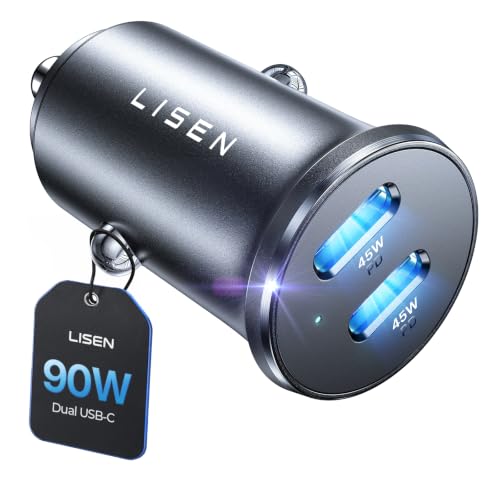
Best for: Drivers charging two USB-C devices
The LISEN 90W car charger is a compact 12V adapter with two USB-C ports. Each port is rated for up to 45W, giving it enough output for a phone and tablet at the same time. It supports USB Power Delivery 3.0 and QC3.0, so compatible devices can charge faster than they would through a basic car adapter. The maker claims an iPhone 16 can reach 83% charge in about 30 minutes with a suitable cable.
Its metal-alloy shell gives the charger a sturdier feel than many plastic models and helps move heat away from the internal components. The body measures about 2.1 inches long by 0.9 inches wide, so it should leave less clutter around the car’s power socket. LISEN also lists UL, CE, FCC, and RoHS certifications, along with V-0 flame-retardant PC material. At around $10, it offers a lot of charging capacity for the price, but actual speeds depend on the device, cable, and vehicle socket.
Pros
- Two USB-C ports can provide up to 45W each.
- PD 3.0 and QC3.0 support suit many modern devices.
- Small metal body fits neatly in most 12V sockets.
Cons
- It includes no charging cables, so compatible cables cost extra.
- Actual output may vary by vehicle socket and connected devices.
3. 3-Port USB-C/USB-A Car Charger Adapter

Best for: Families charging multiple devices on road trips
This compact car adapter fits 12V to 24V vehicles, including cars, trucks, SUVs, and sedans. It has two USB-C ports and one USB-A port, so passengers can charge phones, tablets, watches, GPS units, or other USB devices from one outlet. The listed output reaches 67W, with up to 37W through USB-C and 30W through USB-A.
Its main advantage is flexibility. USB-C devices can use PD charging, while older cables still work through the USB-A port with QC 3.0 support. The manufacturer says compatible phones can reach 60% charge in about 35 minutes, though charging speed depends on the device, cable, and power sharing between ports. The metal housing should handle regular vehicle use and help move heat away from the charging components. Built-in protection covers over-current, over-voltage, overheating, and short circuits. At around $10, it is an inexpensive way to update an older car’s charging setup. A one-year replacement policy is included.
Pros
- Three ports support two USB-C devices and one USB-A device at the same time.
- Up to 67W of listed output supports fast charging for compatible phones, tablets, and some laptops.
- Metal housing and protection circuits address heat, short circuits, and excess current.
Cons
- The maximum output is shared when several devices charge, so each device may charge more slowly.
- Fast charging requires compatible cables and devices, and the 37W USB-C limit may not suit larger laptops.
2. LISEN USB-C Car Charger, 2-Pack
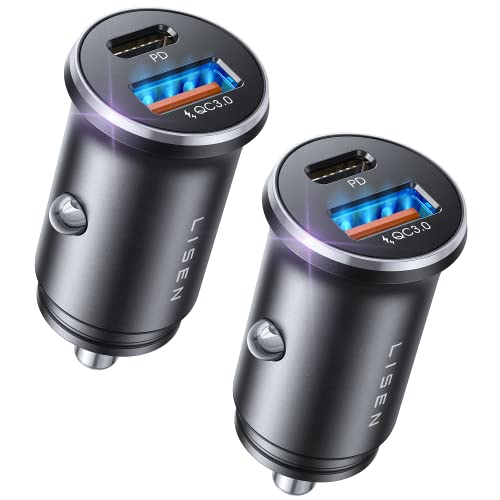
Best for: Two-car households and daily commuters
The LISEN car charger comes in a two-pack for use in separate vehicles or as a spare. Each thumb-sized adapter fits a standard 12V cigarette lighter socket and sits nearly flush with the surrounding trim. Its aluminum-alloy shell gives it a sturdier feel than basic plastic chargers, while the compact shape leaves little clutter around the console.
Each unit has one 36W USB-C PD port and one 18W USB-A QC port. The USB-C connection suits newer iPhones and other compatible phones, while USB-A covers many Android devices, tablets, and accessories. The charger carries a stated 69W rating, but the ports are not designed to deliver maximum output to multiple devices at once. Around $10 for two, it offers useful coverage for shared cars, road trips, and small vehicle fleets. LISEN also includes a 24-month replacement promise.
Pros
- Two adapters cover separate cars, glove-box storage, or backup use.
- Aluminum construction helps manage heat and resists melting or plastic odor.
- USB-C PD and USB-A QC support many current phones and accessories.
Cons
- The 69W headline can mislead, since one port delivers full-speed charging at a time.
- It has only two charging ports, so larger groups may need a multi-port adapter.
1. 4-Port USB-C Car Charger

Best for: Families charging four devices on road trips
This compact USB-C car adapter measures 2.71 by 1.56 inches and fits 12-24V cars, trucks, SUVs, and pickups. It has two USB-C ports and two USB-A ports, so four devices can charge at once. The listed 90W output includes up to 45W through USB-C and up to 45W through USB-A, though available power may be shared between connected devices.
Its charging claims cover many current phones, tablets, power banks, cameras, GPS units, and other USB devices. The manufacturer says compatible iPhones can reach 80% in 30 minutes, while some iPads can reach 60% in that time. Supported Samsung phones are rated for up to 80% in 35 minutes. A built-in power management chip adds over-current, over-voltage, overload, overheat, and short-circuit protection. The high-density metal shell should help move heat away from the electronics. At around $13, it offers a lot of ports for a low price.
Pros
- Four ports support simultaneous charging for passengers and drivers.
- Up to 45W USB-C output suits phones, tablets, and some small devices.
- Metal housing and multiple safety protections address heat and electrical faults.
Cons
- Total output can be divided across four devices, reducing charging speed.
- The package includes only the adapter, so USB-C and USB-A cables cost extra.
Buying Guide
The most important factor is charging power, measured in watts. A model with 30W or more can charge one modern phone quickly, while 60W or higher suits tablets and some laptops.
- Power output: Choose USB-C Power Delivery at 30W minimum for phones. Select 45W to 65W if you also charge tablets, handheld consoles, or compatible laptops.
- Port layout: Pick one USB-C port for the fastest charge, or two ports for passengers. Check the split output, since a 60W charger may drop to 30W per port.
- Vehicle compatibility: Confirm the adapter supports your car’s 12V or 24V socket. It should also list protections against overheating, overcurrent, and short circuits.
- Charging standards: Look for USB-C PD and, when supported by your phone, PPS. PPS can improve charging efficiency on many recent Samsung and Google phones.
- Size and price: A compact unit under 3 inches long leaves room around the socket. Premium models commonly cost $25 to $60, while a suitable cable may cost another $10 to $25.
If you must compromise, prioritize verified USB-C power delivery and enough wattage for your main device.
Frequently Asked Questions
What makes a premium car charger adapter worth buying?
A premium car charger adapter is worth buying when it delivers reliable power, fits your vehicle, and includes safety protections. Look for USB-C Power Delivery, a second USB-A port, and protection against overheating or voltage spikes. A 30W USB-C output can charge many newer phones quickly during short drives.
How do I choose a high-end car phone charger for my vehicle?
Choose a high-end car phone charger by checking its socket fit, output wattage, cable type, and device compatibility. Most 12V outlets accept standard adapters, but some vehicles use covered or tight sockets. For example, a 45W USB-C model can support many phones, tablets, and navigation devices from one port.
Can a premium vehicle charger power more than one device?
Yes, a premium vehicle charger can power more than one device if it has multiple ports and enough total wattage. Check the combined output, not just the highest single-port figure. A 60W adapter might provide 45W through USB-C and 15W through USB-A when two devices charge together.
Are expensive car charging adapters safer than cheap models?
Expensive car charging adapters are not automatically safer, but reputable premium models often provide better protection, materials, and documented ratings. Check for overcurrent, overvoltage, short-circuit, and temperature safeguards from a known manufacturer. A charger with a 12V to 24V input range suits many cars, trucks, and vans.
Conclusion
The 4-Port USB-C Car Charger is the top pick for drivers who need to power several phones, tablets, or accessories during one trip. If your priority is the fastest charge for one device, choose a smaller, high-output USB-C model instead, since it may deliver more power to a single port without taking as much space. Before buying, double-check the adapter’s size, vehicle and device compatibility, number of ports, and current price. Premium materials and extra ports matter only when they fit your routine. Check that your charging cables support the advertised wattage, too. A compact plug suits small consoles, while families and rideshare drivers may prefer four-port flexibility. Choose the charger that matches your devices, cabin space, and daily charging needs.