
The AstroAI S8 Car Battery Jump Starter is the best lithium car jump starter for most buyers because it offers a compact, practical way to handle a dead car battery. Its portable design makes it easier to keep in a glove box or roadside kit than a bulky battery pack. It suits drivers who want backup power without carrying a full-size booster.
This guide is for commuters, road-trippers, and anyone preparing for battery trouble. For portable jump starters, rated starting current, battery capacity, clamp quality, cable length, and overall size matter most. A higher current rating can offer broader vehicle compatibility, depending on the manufacturer’s guidance. The six picks below are ranked with clear reasons and honest drawbacks for each, so you can match a power pack to your vehicle, driving habits, and emergency plan.
Quick Comparison
| # | Product | Best For | Price | |
|---|---|---|---|---|
| 1 | AstroAI S8 Car Battery Jump Starter | Drivers wanting a compact backup | ~$45 | View → |
| 2 | AstroAI P10 Lithium Car Jump Starter | Frequent road trippers needing extra power | ~$70 | View → |
| 3 | NOCO Boost GB20 Jump Starter | Small-car owners seeking simple operation | ~$80 | View → |
| 4 | BIUBLE Car Jump Starter | Budget-conscious drivers building an emergency kit | ~$35 | View → |
| 5 | NOCO Boost GB50 Jump Starter | Pickup and SUV owners needing more power | ~$150 | View → |
| 6 | WOLFBOX MV24 Jump Starter | Drivers wanting a screen-equipped starter | ~$108 | View → |
6 Top Lithium Jump Starters
The picks below are ranked by power, portability, safety features, and value, counting down to the top choice.
6. WOLFBOX MV24 Jump Starter

Best for: Drivers wanting high-capacity roadside backup
The WOLFBOX MV24 is a 12V jump starter for cars, trucks, boats, and other vehicles with gasoline or diesel engines under 10 liters. Its 88.8Wh battery and 4,000A output provide substantial starting power for low-battery emergencies. Around $108, it costs more than compact emergency boosters, but the higher capacity may suit larger vehicles and frequent travel.
A built-in LCD shows the unit’s power and operating status. Charging is a strong point, with one 65W USB-C input/output port, one QC3.0 USB-A port, and an included PD65W charger. The company states a full recharge takes about 1.3 hours. Those ports can also charge phones, tablets, and some laptops. A one-touch boost mode helps with low-voltage batteries, while the light offers high-beam, SOS, and strobe settings. The unit carries an IP64 rating and lists UL, FCC, CE, and CA65 safety testing.
Pros
- 88.8Wh capacity and 4,000A output support many 12V vehicles.
- 65W USB-C charging can refill the pack in about 1.3 hours.
- LCD readout and SOS, strobe, and high-beam lighting aid roadside use.
Cons
- It is rated for engines under 10 liters, so larger vehicles fall outside the stated range.
- IP64 resists dust and splashing, but it is not waterproof for submersion. Clamps also require careful polarity checks before use.
5. NOCO Boost GB50 Jump Starter
Best for: Drivers needing reliable roadside backup
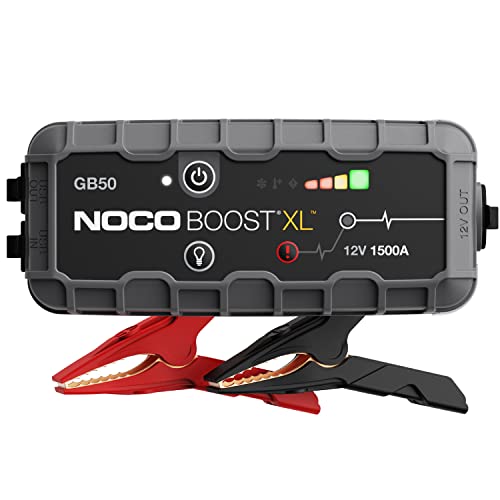
The NOCO Boost GB50 is a portable 12V jump starter for cars, trucks, and other vehicles. Its 1,500-amp lithium battery is rated for up to 30 starts per charge, with support for gasoline engines up to 7.0 liters and diesel engines up to 4.5 liters. At 2.7 pounds, it can fit in many glove boxes or emergency kits, though it is larger than basic battery packs.
Safety features are a major advantage. Spark-proof protection and reverse-polarity safeguards help reduce connection mistakes. The rubberized housing has an IP65 rating for resistance to dust and water, while the included clamps use high-conductivity materials. It also works as a power bank for phones and tablets, then recharges in about five hours. A 200-lumen LED flashlight adds seven modes, including SOS and strobe. Around $150, it costs more than small jump packs, but includes a one-year warranty, USB-C cable, and storage bag.
Pros
- Supports engines up to 7.0L gas and 4.5L diesel.
- Reverse-polarity and spark-proof protection make connections safer.
- Combines emergency starting power with a 200-lumen flashlight and USB power bank.
Cons
- At 2.7 pounds, it may feel heavy for compact emergency kits.
- The advertised 30 starts depends on vehicle size, battery condition, temperature, and charge level.
4. BIUBLE Car Jump Starter
Best for: Drivers needing roadside backup
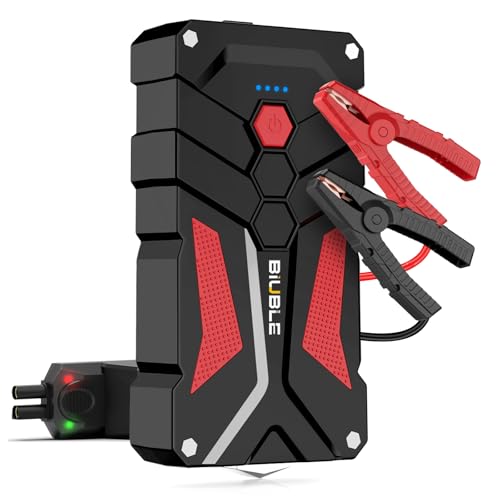
The BIUBLE jump starter is a compact 12-volt battery booster for cars, trucks, motorcycles, boats, RVs, tractors, ATVs, UTVs, lawnmowers, and snowmobiles. Its listed 5,000-amp peak output supports gasoline engines up to 7.0 liters and diesel engines up to 5.5 liters. The manufacturer claims up to 40 starts per charge, though actual results depend on battery condition, engine size, and temperature. It is rated for use from -4°F to 140°F.
Its useful extras make it more than an emergency jumper. Two USB ports provide 5V output, one at 3A and another at 2.4A, for phones and tablets. The built-in light offers standard, strobe, and SOS modes. Smart cables provide reverse-polarity, spark, over-current, overload, and high-temperature protection, with sounds and flashing lights for incorrect connections. The package includes a USB-C charging cable, but not a wall adapter. At around $35, it offers strong roadside utility for a modest price. Charge it fully before the first use, then recharge it every two to three months.
Pros
- Supports engines up to 7.0L gas and 5.5L diesel.
- Includes two USB charging outputs for mobile devices.
- Three flashlight modes help during roadside emergencies.
Cons
- The package does not include a wall charging adapter.
- It requires regular recharging every two to three months, even when rarely used.
3. NOCO Boost GB20 Jump Starter
Best for: Drivers with aging car batteries
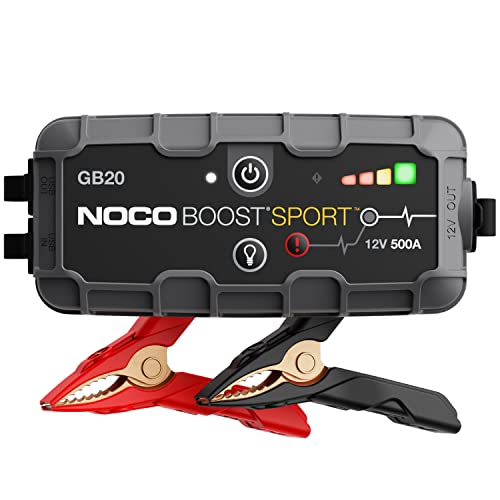
The NOCO Boost GB20 is a portable 12V jump starter for cars, trucks, and other gas-powered vehicles. Its 500-amp lithium battery can provide up to 20 starts per charge on engines up to 4.0 liters. At 2.4 pounds, it fits many glove boxes and emergency kits without taking much space. The included clamps connect to the battery, while reverse-polarity and spark protection help reduce connection mistakes.
This unit does more than start a car. Its power bank can recharge a phone or tablet during an emergency, and the battery takes about three hours to recharge. A 100-lumen LED flashlight offers seven modes, including SOS and strobe. The rubberized IP65 housing helps protect against dust, water spray, and impacts. Around $80, it costs more than basic cable-style boosters, but the compact design and one-year warranty add practical value. The box includes a USB-C charging cable and microfiber storage bag.
Pros
- Starts 12V gas engines up to 4.0 liters with 500 amps of peak power.
- Provides phone or tablet charging during roadside emergencies.
- Includes a 100-lumen flashlight with seven modes, including SOS.
Cons
- It is limited to 12V systems and gas engines up to 4.0 liters.
- The battery needs about three hours to recharge before full readiness.
2. AstroAI P10 Lithium Car Jump Starter

Best for: Drivers needing compact roadside backup
The AstroAI P10 is a 12V lithium jump starter for cars, motorcycles, SUVs, lawn equipment, tractors, and motorboats. Its listed 5,000-amp peak current supports gas engines up to 10 liters and diesel engines up to 8 liters. It also works as a portable power bank through USB-A, with QC 3.0 output rates of 5V/3A, 9V/2A, or 12V/1.5A. Around $70, it offers more emergency utility than a basic booster pack.
This unit measures 7.09 by 1.57 by 3.35 inches and weighs 490 grams, so it should fit in many glove boxes or tool kits. A built-in LED light provides illumination, SOS, and strobe modes for roadside visibility. The clamps include protections against reverse polarity, overcurrent, overcharging, overheating, short circuits, sparks, and other electrical faults. The manual should be reviewed before first use, and AstroAI recommends recharging it every three months. The 5,000-amp rating is a peak figure, not a sustained output, so engine size, battery condition, and weather still affect results.
Pros
- Supports large engines, including up to 10L gas and 8L diesel.
- Compact 490-gram body takes less storage space.
- USB-A charging and three light modes add emergency utility.
Cons
- USB-A connectivity may feel dated for devices that use USB-C.
- Requires regular charging every three months, even when rarely used.
1. AstroAI S8 Car Battery Jump Starter

Best for: Emergency roadside starts in compact vehicles
The AstroAI S8 is a portable 12V jump starter for cars, SUVs, pickups, motorcycles, and lawnmowers. Its 1,500-amp peak output and 45C lithium battery are rated for gas engines up to 6.0 liters and diesel engines up to 3.0 liters. At 7.9 by 4.5 by 3.7 inches and 0.95 pounds, it takes up less space than traditional lead-acid jump packs. The price is usually around $45, though it can change.
Its low-voltage boost mode adds useful control. When the battery falls below 9 volts, a green indicator flashes and unlocks the Boost button for fully drained batteries. The metal clamps and smart cable help manage heat, loose connections, and incorrect hookups. Eight built-in protections cover reverse polarity, reverse connection, overcurrent, overvoltage, overload, overcharge, over-discharge, and short circuits. It also works as a power bank and flashlight with standard, strobe, and SOS modes. Keep it at a suitable temperature, since extreme cold can reduce battery performance.
Pros
- Compact 0.95-pound body fits in many glove boxes or travel bags.
- Boost mode can help with batteries below 9 volts.
- Eight safety protections reduce risks from wiring and charging mistakes.
Cons
- The engine rating limits diesel use to 3.0 liters, which excludes many larger trucks.
- Cold weather can reduce performance, so winter storage and use require extra care.
Buying Guide
The most important factor is usable starting current, not the largest peak number on the box. Choose a 12-volt lithium jump pack rated for your engine, with extra capacity for cold weather and an older battery.
- Engine match: For a gasoline engine up to 4.0 liters, look for at least 800 peak amps. Diesel engines commonly need 1,000 to 1,500 amps, depending on temperature and battery condition.
- Battery capacity: Aim for 10,000 to 20,000 mAh, or roughly 37 to 74 watt-hours. This range usually supports several starts before recharging.
- Safety protection: Require reverse-polarity, short-circuit, overcharge, and over-temperature protection. A clear error light or alarm can prevent a bad connection.
- Clamps and cables: Choose insulated clamps with jaw openings near 0.5 inch and cables at least 12 inches long. Thicker leads handle high current better.
- Charging and storage: USB-C input can refill the pack faster. Seek a full recharge under four hours, a battery gauge, and storage temperatures around 32 to 113°F.
If you must compromise, prioritize engine-rated starting current, then choose the largest practical battery pack.
Frequently Asked Questions
How do lithium car jump starters work?
Lithium car jump starters use a rechargeable battery to send a short, high-current burst through the vehicle’s battery terminals. Most compact models provide enough power for four- or six-cylinder cars, while larger units suit trucks and engines above 6.0 liters.
What size lithium jump starter do I need for my car?
The right lithium jump starter is one whose rated current matches your engine size and battery type, with the manufacturer’s guide as the final check. A small gasoline car may need 400 to 800 peak amps, while a diesel truck often requires more.
Can a portable battery booster start a dead car battery?
Yes, a portable lithium booster can start a car with a dead battery if it has enough output and the battery is not damaged. Many units handle four- to six-cylinder gasoline engines, but a completely failed battery may need replacement instead.
Are lithium jump starters safe to keep in a car?
Yes, lithium jump starters are generally safe to store in a car when you follow the manual, protect the clamps from contact, and avoid excessive heat. Do not leave one in a parked vehicle during extreme temperatures, since many makers specify storage near 32 to 104 degrees Fahrenheit.
Conclusion
AstroAI S8 Car Battery Jump Starter remains the top pick for drivers who want a compact, straightforward emergency starter for everyday cars, SUVs, and roadside backup. If your priority is starting larger engines or powering more devices, choose a higher-capacity model with stronger peak current and extra USB outputs instead. Before buying, double-check the unit’s size, vehicle compatibility, package quantity, and current price, since bundles and listings can change. Pay close attention to engine type and displacement, especially with diesel vehicles, because a small pack may not provide enough starting power. A clear display, protected clamps, and a storage case can also make roadside use less stressful when conditions are cold, dark, or wet.