
Zerex Asian Vehicle Antifreeze/Coolant is the top pick for most buyers because its formula is designed for many Toyota, Honda, Nissan, and other Asian vehicles. For shoppers seeking the best coolant for radiator, it offers a practical starting point, but the vehicle manual still decides compatibility. Many versions come as a 50/50 premix, which makes routine top-ups simpler and reduces measuring.
This guide is for drivers replacing old fluid, fixing a low reservoir, or choosing coolant before service. The key factors are the required coolant chemistry and the amount your cooling system holds. Check the manual or manufacturer label before mixing formulas, since color alone does not confirm compatibility. The five picks below are ranked with clear reasons and honest drawbacks for each, so you can compare fit, format, and value without guessing.
Quick Comparison
| # | Product | Best For | Price | |
|---|---|---|---|---|
| 1 | Zerex Asian Vehicle Antifreeze/Coolant | Asian Cars Needing OEM-Style Coolant | ~$18 | View → |
| 2 | Zerex Asian Vehicle Antifreeze/Coolant | Budget-Conscious Asian Vehicle Owners | ~$18 | View → |
| 3 | Honda Type 2 Antifreeze/Coolant | Honda Owners Wanting Factory Formula | ~$31 | View → |
| 4 | Zerex Dex-Cool Antifreeze Coolant | GM Vehicles Requiring Dex-Cool | ~$22 | View → |
| 5 | PEAK Global Antifreeze and Coolant | Mixed-Fleet Cooling System Maintenance | ~$20 | View → |
5 Top Radiator Coolant Picks
These radiator coolants are ranked by protection, compatibility, and value, counting down to the top pick.
5. PEAK Global Antifreeze and Coolant

Best for: Long-term coolant maintenance across vehicles
This 1-gallon jug contains concentrated, ethylene glycol-based antifreeze and coolant for cars and light, medium, or heavy-duty trucks. PEAK lists it for American, Asian, and European vehicles across all makes, models, and years. Because it is concentrate, you must mix it with water according to the vehicle and product directions before filling. That extra step adds time compared with premixed coolant.
The Organic Acid Technology formula is designed to protect cooling-system metals from rust and corrosion. It can also work with other coolant formulations, which helps when topping off a system with existing antifreeze. Its amber color should not change the appearance or performance of the coolant already in the system. Proper maintenance can support protection for the vehicle’s lifetime, but that does not remove the need to inspect hoses, belts, the radiator, and coolant condition. The formula includes Denatonium Benzoate, a bittering agent that helps discourage accidental swallowing. At around $20 per gallon, it offers a practical option for routine service and larger cooling systems.
Pros
- One gallon provides a useful supply for a full refill or several top-offs, depending on system capacity.
- Compatible with many American, Asian, and European vehicles, including trucks.
- Organic Acid Technology helps guard cooling-system metals against rust and corrosion.
Cons
- This is concentrate, so it needs proper dilution before use.
- “Lifetime” protection depends on correct mixing, regular maintenance, and a healthy cooling system.
4. Zerex Dex-Cool Antifreeze Coolant
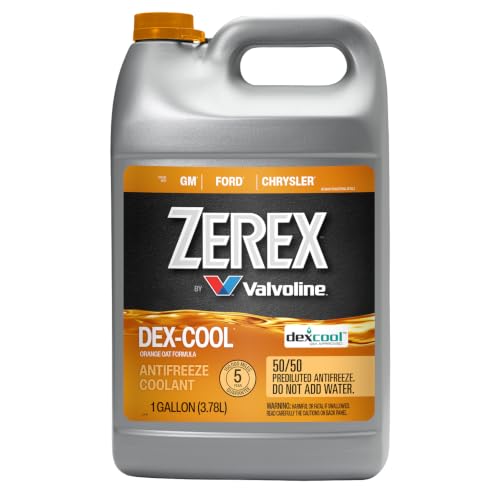
Best for: GM vehicles requiring Dex-Cool coolant
Zerex Dex-Cool 50/50 is a one-gallon jug of premixed orange antifreeze. It uses deionized water, so no additional mixing is needed before adding it to a compatible cooling system. The formula is rated for freeze protection down to -34°F and boil protection up to 265°F. Its organic acid technology helps resist rust, scale, and corrosion across cooling system metals, including aluminum.
The coolant also targets common rubber and plastic parts, such as gaskets and hoses, without damaging the vehicle’s original finish. Zerex lists a five-year or 150,000-mile guarantee against engine failure caused by freeze-ups or boil-overs. Each batch receives laboratory testing, with added fleet testing for real-world use. A bittering agent, denatonium benzoate, is included at 30 to 50 ppm, but the coolant remains hazardous if swallowed. At around $22, this jug offers a practical option for drivers who need a ready-to-pour replacement.
Pros
- The 50/50 premix saves time and avoids measuring water.
- Protection reaches -34°F for freezing and 265°F for boiling.
- Organic acid additives help protect aluminum, hoses, gaskets, and plastics.
Cons
- It only suits vehicles that specify Dex-Cool or a compatible coolant.
- One gallon may not cover a complete refill on larger cooling systems.
3. Honda Type 2 Antifreeze/Coolant

Best for: Honda owners replacing Type 2 coolant
Honda Genuine Extended Life Antifreeze/Coolant Type 2 comes in a 1-gallon jug, already mixed to a 50/50 ratio with water. It is ready to pour, so there is no separate measuring or mixing step. The blue formula contains ethylene glycol plus denatonium benzoate, a bittering agent. It fits Honda cooling systems that require Type 2 coolant and replaces part number OL999-9011.
The main advantage is a factory-matched formula for compatible Honda vehicles. It helps guard metal and non-metal cooling parts against rust and corrosion, while providing freeze protection and resistance to boil-over in temperature extremes. Under normal conditions, Honda lists a service life of up to five years or about 60,000 miles. At around $31 per gallon, it costs more than many generic coolants, but the pre-diluted mix removes one common source of service errors. Check your owner’s manual before buying, since this coolant is not a universal replacement for every Honda system.
Pros
- Pre-mixed 50/50 formula is ready to use from the jug.
- Protects metal and non-metal cooling components from rust and corrosion.
- Offers up to five years or 60,000 miles of service under normal conditions.
Cons
- Only suits cooling systems that specify Honda Type 2 coolant.
- Around $31 per gallon costs more than many basic aftermarket options.
2. Zerex Asian Vehicle Antifreeze/Coolant

Best for: Asian vehicles needing red HOAT coolant
Zerex Asian Vehicle Red is a ready-to-use, 50/50 antifreeze and coolant sold in a 1-gallon container. It targets Asian makes such as Toyota, Lexus, and Scion that specify red, silicate-free HOAT coolant. The formula is also borate-free, so buyers do not need to dilute it with water before adding it to a compatible cooling system. At around $18, it offers a practical option for a routine coolant change or a small top-off.
The formula carries a stated service rating of up to 5 years or 150,000 miles. Its phosphate-based Hybrid Organic Acid Technology is designed to protect aluminum and other cooling-system metals from rust and corrosion. The silicate- and borate-free chemistry also helps limit scale and deposits. Zerex lists compliance with JIS K 2234-1994, Hyundai/KIA MS 591-08, Mitsubishi ES-64217, Ford WSS-M97B55-A, ASTM 3306, ASTM D4985, and Federal Specification A-A-870A. These specifications help, but the vehicle manual remains the deciding source.
Pros
- Prediluted 50/50 formula requires no mixing before use.
- Rated for 5 years or 150,000 miles under the stated service guidance.
- Silicate- and borate-free chemistry helps reduce deposits and corrosion.
Cons
- It is not a universal coolant, so buyers must confirm the vehicle’s required color and chemistry.
- One gallon may not cover a full cooling-system refill on larger vehicles.
1. Zerex Asian Vehicle Antifreeze/Coolant

Best for: Asian vehicles needing blue coolant
Zerex Asian Vehicle Blue is a one-gallon jug of 50/50 prediluted antifreeze and coolant. It is ready to pour, so you do not need to add water before filling the cooling system. The silicate-free, borate-free formula uses phosphate HOAT chemistry for vehicles that call for blue coolant, including many Honda, Nissan, Kia, and Hyundai models.
Its stated service protection reaches five years or 150,000 miles, although your vehicle’s maintenance schedule should take priority. The formula helps guard cooling-system metals against rust, corrosion, scale, and deposits. It meets specifications such as Hyundai/Kia MS 591-08, Mitsubishi ES-64217, JIS K 2234-1994, ASTM D3306, and ASTM D4985. The jug also contains 30 to 50 ppm of denatonium benzoate, a bittering agent. Around $18, it offers a practical option for a scheduled coolant change, but confirm your owner’s manual before purchase.
Pros
- Ready-to-use 50/50 mixture avoids measuring and water mixing.
- Designed for blue, silicate-free coolant requirements in many Asian vehicles.
- Five-year or 150,000-mile protection provides a long service interval.
Cons
- It is only suitable when the vehicle specifies compatible blue HOAT coolant.
- A one-gallon jug may not cover a full cooling-system refill on larger vehicles.
Buying Guide
Vehicle compatibility is the most important factor when choosing radiator coolant. The correct formula protects against corrosion and overheating, while the wrong one can damage seals, hoses, or aluminum parts.
- Vehicle specification: Match the coolant to the automaker’s standard in the owner’s manual, such as Toyota SLLC, Ford WSS-M97B44-D, or GM Dex-Cool. Do not choose by color alone.
- Premix or concentrate: Choose a 50/50 premix for quick top-ups. Concentrate usually needs a 1:1 mix with distilled water, and antifreeze should not exceed 70% of the mixture.
- Temperature protection: A 50/50 blend generally protects to about -34°F (-37°C). Drivers in colder regions may need a stronger approved mixture, but the label must support it.
- Coolant chemistry: OAT, HOAT, and IAT formulas use different inhibitor packages. Never mix types unless the vehicle maker or product label specifically allows it.
- Quantity and service life: Check the cooling-system capacity before buying. A small car may need 1 to 2 gallons, while some trucks need more. Select a bottle with a stated replacement interval, often 3 to 5 years or 30,000 to 150,000 miles.
If you cannot satisfy every factor, prioritize the exact manufacturer specification over price, color, or extended service claims.
Frequently Asked Questions
How do I choose the right coolant for my radiator?
Choose a coolant that matches your vehicle maker’s specification, not just its color. Check the owner’s manual or the label on the expansion tank before buying. Premixed antifreeze usually contains about 50% coolant and 50% deionized water, a common ratio for protection near minus 34°F.
What type of antifreeze is best for a car radiator?
The best antifreeze is the type approved for your car’s cooling system and engine materials. Some vehicles require OAT, HOAT, or IAT formulas, and these are not always interchangeable. A five-year, 150,000-mile coolant may suit some newer cars, while older models may need a shorter service interval.
Can I mix different radiator coolants?
You should not mix different coolant formulas unless the product label or vehicle maker specifically allows it. Incompatible additives can reduce corrosion protection and create deposits inside the cooling system. If the existing fluid is unknown, a complete drain and flush is safer than adding one bottle of another type.
Are premixed coolants better than concentrated antifreeze?
Premixed coolant is easier and safer for most drivers because it already contains the correct water ratio. Concentrated antifreeze costs less per usable gallon but requires distilled or deionized water for dilution. For example, a 50:50 mixture commonly protects cooling systems to roughly minus 34°F.
Conclusion
Zerex Asian Vehicle Antifreeze/Coolant remains the top pick for drivers who need a formula designed for many Asian vehicles and want clear application guidance. If your priority is maximum coverage across several makes, choose a trusted universal coolant instead, but confirm that its chemistry matches your vehicle before filling the radiator. Before buying, double-check the bottle size, vehicle compatibility, required quantity, and current price, since a low shelf price may not cover a full drain-and-refill. Some vehicles call for a premixed 50/50 solution, while others use concentrate diluted with distilled water. Follow the owner’s manual, avoid mixing incompatible coolant colors, and keep enough product for future top-offs. A small reserve can prevent an inconvenient delay.