
The BOSCH 6081C HEPA Cabin Air Filter is the best budget cabin air filter for most buyers because its HEPA media offers stronger fine-particle filtration than a basic particulate filter. It is a practical replacement for vehicle HVAC systems and can help reduce dust, pollen, and other airborne particles inside the cabin.
This guide is for drivers replacing a clogged filter, managing seasonal allergies, or comparing lower-cost maintenance parts. Fit matters first, so check your vehicle’s make, model, year, and filter dimensions before ordering. Filter material matters too, since HEPA media targets smaller particles than standard paper or pleated filters. The five picks below are ranked with clear reasons and honest drawbacks for each.
Quick Comparison
| # | Product | Best For | Price | |
|---|---|---|---|---|
| 1 | BOSCH 6081C HEPA Cabin Air Filter | Allergy-sensitive daily commuters | ~$16 | View → |
| 2 | CARORY CF157 Cabin Air Filter | Budget-conscious vehicle owners | ~$8 | View → |
| 3 | BOSCH 6092C HEPA Cabin Air Filter | HEPA filtration seekers | ~$14 | View → |
| 4 | CF150 Cabin Air Filter with Activated Carbon | Odor-conscious city drivers | ~$9 | View → |
| 5 | CF182 Cabin Air Filter | Drivers replacing standard filters | ~$8 | View → |
5 Budget Cabin Filters Worth Considering
The picks are ranked by value, filtration features, and fit, counting down to the top budget cabin filter.
5. CF182 Cabin Air Filter

Best for: Budget-conscious Honda and Acura owners
The CF182 is a replacement cabin air filter with activated carbon for a wide range of Honda and Acura vehicles. Coverage includes the Honda Fit from 2009–2020, Civic from 2016–2025, CR-V from 2017–2025, HR-V from 2016–2025, and Odyssey from 2018–2025. It also fits select Accord, Clarity, CR-Z, Insight, Pilot, BR-V, and City models.
Acura coverage includes the Integra from 2023–2025, MDX from 2022–2025, RDX from 2019–2025, and TLX from 2021–2025. That broad year range is the main draw, especially for owners who want a low-cost replacement. Activated carbon may help reduce some outside odors, but this is not advertised as a HEPA filter. The CF182 cross-references many Honda, Acura, and aftermarket numbers, including 80291-T5R-A01, 80292-TBA-A11, CF11182, and CU21003. At around $8, it costs less than many branded replacements, though prices can change.
Pros
- Activated carbon may help limit some cabin odors.
- Fits many Honda and Acura models from 2009–2025.
- Numerous reference numbers make compatibility checks easier.
Cons
- The long fitment list still requires checking your exact vehicle and trim.
- No stated replacement interval, filtration rating, or measured odor-removal performance.
4. CF150 Cabin Air Filter with Activated Carbon

Best for: Ford truck owners wanting odor control
This cabin air filter uses a dust-catching filter layer with activated carbon. It fits a wide range of Ford vehicles, including the F-150 from 2015–2025, F-150 Lightning from 2022–2025, Expedition from 2018–2024, and Super Duty F-250 through F-600 models from 2017–2025, depending on the truck. It also fits the 2018–2024 Lincoln Navigator and 2016–2024 Lobo.
The long reference-number list makes cross-checking easier. Compatible numbers include Ford DR3Z-19N619-A, FL3Z-19N619-A, and JL7Z-19N619-A, along with aftermarket numbers such as CF12150, CAF1953, FP-79, and PC8214. The carbon layer may help reduce everyday odors, while the filter media captures dust, pollen, and other small particles before they enter the cabin. At around $9, it offers a low-cost replacement option, but fitment remains the key detail to verify before ordering.
Pros
- Activated carbon can help reduce common cabin odors.
- Broad coverage includes F-150, Super Duty, Expedition, and Navigator models.
- Around $9 makes it an inexpensive routine replacement.
Cons
- The listing does not provide the filter’s physical dimensions, so buyers should confirm the part number or vehicle fit first.
- No replacement interval is specified, leaving owners to follow the vehicle manual or inspect the filter condition.
3. BOSCH 6092C HEPA Cabin Air Filter
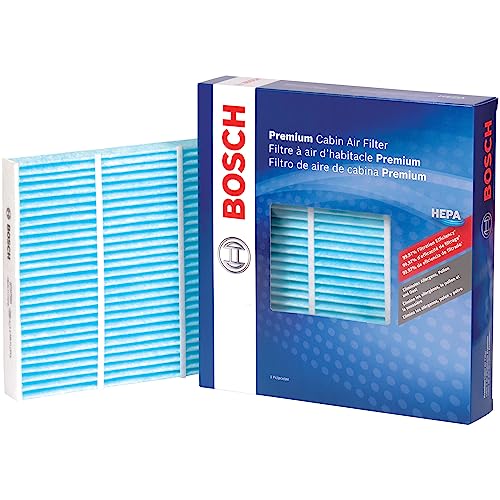
Best for: Drivers seeking fine-particle filtration
The BOSCH 6092C is a HEPA cabin air filter for select Subaru and Toyota vehicles. Its filtration media is rated at 99.97% efficiency for particles measuring 0.3 microns, based on ISO 29463-3:2011. That makes it suited to drivers who want stronger particle capture than a basic cabin filter. Bosch recommends replacing it at least every 12 months or 12,000 miles.
Its three-layer design combines a melt-blown electrostatic layer, dense filter media, and a static cotton layer that adds capacity. Structural ribs help the filter keep its shape during service. It does not use a chemical odor neutralizer, so it avoids adding a fragrance-like smell to the cabin. At around $14, it offers a relatively low-cost maintenance upgrade. Fitment covers vehicles such as the 2020-21 Subaru Ascent, 2018-21 Crosstrek, 2016-21 Toyota Prius, and 2019-20 RAV4. Check the exact trim before ordering.
Pros
- Captures 99.97% of 0.3-micron particles under the stated HEPA test standard.
- Three filter layers provide electrostatic capture and added media capacity.
- Structural ribs support filter shape throughout its service life.
Cons
- Compatibility is limited, and trim differences can affect fitment.
- It does not include an odor-neutralizing chemical layer, which may matter for smoke or strong smells.
2. CARORY CF157 Cabin Air Filter

Best for: Toyota owners needing broad fitment
The CARORY CF157 is a replacement cabin air filter with activated carbon. It is listed for many Toyota vehicles, including the 2018–2025 Camry, 2019–2025 Corolla and RAV4, 2016–2025 Prius, 2020–2025 Highlander, and 2021–2025 Sienna. It also fits select Lexus, Subaru, and Mazda models. Activated carbon can help reduce common cabin odors, while the filter material catches airborne dust before it enters the passenger area.
The wide vehicle list is the main reason to consider this filter. Coverage includes newer models such as the 2024–2025 Grand Highlander, 2024–2025 Lexus TX, and 2025 Lexus UX300H. It replaces several original-equipment numbers, including Toyota 87139-0E040 and Subaru 72880-FL00A, along with many aftermarket references. At around $8, it costs little compared with many dealer-supplied replacements. Fitment still requires care, especially for the Toyota C-HR, which is listed for Japan-built models only, identified by a VIN beginning with “J.”
Pros
- Activated carbon may help reduce odors inside the cabin.
- Fits a large range of Toyota, Lexus, Subaru, and Mazda vehicles.
- Around $8 makes routine filter replacement inexpensive.
Cons
- The long fitment list requires checking the exact model, year, and VIN.
- The provided details do not include filter dimensions or replacement instructions.
1. BOSCH 6081C HEPA Cabin Air Filter
Best for: Drivers wanting fine-particle filtration
The BOSCH 6081C is a HEPA cabin air filter designed to reduce fine particles entering your vehicle. Bosch rates it to capture 99.97% of particles at 0.3 microns, based on ISO 29463-3:2011 testing standards. That makes it suited to drivers concerned about dust, pollen, and other airborne debris.
Its three-layer design combines dense filter media, a melt-blown electrostatic layer, and a static cotton layer for added particle capacity. Structural ribs help the filter keep its shape during service. At around $16, it costs more than basic cabin filters but remains reasonably priced for a yearly replacement. Bosch recommends changing it at least every 12 months or 12,000 miles, whichever comes first. It does not use a chemical odor neutralizer, so its focus stays on particle filtration rather than masking smells.
Pros
- Captures 99.97% of 0.3-micron particles under the stated HEPA testing standard.
- Three filtration layers help trap fine debris and hold more particles.
- Reinforced structural ribs support the filter’s shape over its service interval.
Cons
- It will not chemically neutralize odors or remove every gas-based smell.
- Fitment depends on the vehicle, so buyers must confirm compatibility before ordering.
Buying Guide
The most important factor is exact vehicle fitment. A filter that matches the car’s year, make, model, and engine creates a proper seal, while the wrong size can let dust bypass the filter.
-
Fitment: Use the manufacturer’s catalog or owner’s manual, and match the listed part number. Do not rely on dimensions alone, since some vehicles use two-piece filters.
-
Price: A reasonable budget range is $10 to $25 for one filter. Packs of two may lower the per-filter cost, but compare the total price with shipping.
-
Filter material: Choose pleated synthetic or nonwoven media with enough folds to catch dust. An activated-carbon layer can reduce odors from traffic and mildew.
-
Replacement schedule: Plan to replace the filter every 12,000 to 15,000 miles or once a year. In dusty areas, during wildfire season, or with frequent unpaved-road driving, six months may be more suitable.
-
Product details: Check the package for the exact part number, airflow direction arrow, and included pieces. Some vehicles need two cabin filters, so confirm the pack count before ordering.
If you cannot have everything, prioritize correct fitment over extra carbon layers, branding, or a lower price.
Frequently Asked Questions
How often should you replace a budget cabin air filter?
Replace a cabin air filter every 12,000 to 15,000 miles, or sooner in dusty conditions. Most cars need a yearly change, but construction roads, wildfire smoke, and heavy pollen can shorten that interval. Check the owner’s manual or compare the old filter with the replacement.
What should you look for in an affordable cabin filter?
Look for the correct vehicle fit, pleated filter media, and a clear replacement interval. A filter that seals around its edges blocks more unfiltered air than one with gaps. Many budget options cost about $8 to $15, but confirm the year, make, model, and engine before ordering.
Can a low-cost cabin air filter improve air quality?
Yes, a low-cost cabin air filter can reduce dust, pollen, and leaves entering the passenger cabin when it fits correctly. It will not remove every odor or replace a vehicle’s air-conditioning service. Change the filter after roughly 12,000 miles, or sooner in smoky areas.
Are cheap cabin air filters worth buying?
Yes, inexpensive cabin filters are worth buying when the part number matches your vehicle and the filter has a solid frame. A basic filter may cost $8 to $15, while a premium version can cost $20 to $40. Check return terms, since a wrong size will not seal properly.
Conclusion
The BOSCH 6081C HEPA Cabin Air Filter is the top pick for drivers who want stronger cabin filtration without premium pricing. If your priority is the lowest upfront cost, choose a basic particulate filter instead, since it may cost less while still catching dust, pollen, and road debris. Before ordering, double-check the filter’s size, your vehicle’s exact year and trim compatibility, package quantity, and current price. A correct fit matters more than a familiar brand name, because an undersized or mismatched filter can leave gaps around the housing. Check the replacement schedule in your owner’s manual, too. Drivers on dusty roads may need a fresh filter sooner than the standard interval.