
The JOLTEKON Car Battery Jump Starter with Air Compressor is the best budget car jump starter for most buyers because it combines battery starting and tire inflation in one device. Its two-in-one design can address two common roadside problems without requiring separate tools.
This guide is for drivers who want practical emergency backup for dead batteries and low tires. When comparing these portable power packs, focus on overall size and battery capacity, since those affect storage and how many starting attempts the unit may support. The six picks below are ranked with clear reasons and honest drawbacks for each. That makes the list useful for commuters, family vehicles, and anyone who keeps emergency gear in the trunk.
Quick Comparison
| # | Product | Best For | Price | |
|---|---|---|---|---|
| 1 | JOLTEKON Car Battery Jump Starter with Air Compressor | Drivers Needing Tire Inflation | ~$100 | View → |
| 2 | OXILAM 6000A Portable Car Jump Starter | Large Engine Emergency Starts | ~$60 | View → |
| 3 | S ZEVZO ET03 Car Jump Starter | Compact Glovebox Backup | ~$60 | View → |
| 4 | Joltekon Car Battery Jump Starter | Everyday Roadside Emergencies | ~$70 | View → |
| 5 | M1 7000A Car Battery Jump Starter | High-Output Truck Owners | ~$36 | View → |
| 6 | 5000A Car Battery Jump Starter with Air Compressor | Road Trips With Flat Tires | ~$60 | View → |
6 Budget-Friendly Car Jump Starters
These picks are ranked by power, portability, safety features, and price, counting down to the top choice.
6. 5000A Car Battery Jump Starter with Air Compressor

Best for: Roadside emergencies and RV kits
This 12V jump starter combines a battery pack, air compressor, tire gauge, phone charger, and emergency light in one unit. Its rated 5,000A peak current is intended for gasoline engines up to 9L and diesel engines up to 8L. The package includes smart jumper cables, a USB-C cable, four air valves, an inflation hose, storage bag, and manual. It costs around $60, though prices can change.
The compressor reaches a listed 150 PSI and supports car, motorcycle, bicycle, ball, and custom modes. Auto-pause stops inflation at the selected pressure. A 3.3-inch LCD shows battery and operating information, while the 500-lumen lamp offers steady, flashing white, flashing red, and SOS modes. The housing uses flame-retardant material and includes 10 protection functions for issues such as sparks, overheating, and temperature extremes. The maker also lists up to 24 months of battery storage, over 1,000 charge cycles, a two-year extended warranty, and lifetime technical support.
Pros
- One device handles jump-starting, inflation, USB charging, and lighting.
- The 150 PSI pump includes auto-pause and four nozzle attachments.
- The 3.3-inch display makes battery status easier to read at night.
Cons
- The 5,000A rating is a peak figure, not a guarantee for every large engine.
- The listing does not provide inflation times, unit weight, or battery capacity, making storage and pump performance harder to judge.
5. M1 7000A Car Battery Jump Starter

Best for: Drivers wanting roadside backup
The VANXIPOW M1 combines a 12V jump starter, tire inflator, power bank, and emergency light in one 554-gram unit. Its advertised 7,000A peak output supports gasoline engines up to 9.0 liters and diesel engines up to 8.0 liters. It can also power motorcycles, boats, ATVs, tractors, and recreational vehicles. Around $36, it costs less than many separate roadside tools.
A large LCD shows battery status, inflation mode, and tire pressure. The 150PSI compressor supports four pressure units and is rated to fill a standard car tire to 50PSI in about one minute. The package includes smart clamps, a detachable air hose, four valve fittings, a USB-C cable, and a storage bag. Its USB output can charge phones and small electronics, while the 600-lumen light offers flash, strobe, and SOS modes. The maker also lists operation from -4°F to 140°F and 10 safety protections. However, those performance claims depend on battery charge, temperature, and vehicle condition.
Pros
- Covers several emergency tasks in one 554-gram pack.
- Supports large engines, up to 9.0L gasoline and 8.0L diesel.
- LCD pressure readings and four valve fittings simplify tire inflation.
Cons
- The compressor needs cooling breaks when it becomes hot, so repeated inflation takes longer.
- One USB output limits charging multiple devices at the same time.
4. Joltekon Car Battery Jump Starter

Best for: Drivers wanting roadside backup
The Joltekon combines a jump starter, tire inflator, power bank, and emergency light in one portable unit. Its 6000A output is rated for gas engines and diesel engines up to 10L, with operation from -4°F to 140°F. The included cables list protections against reverse polarity, sparks, short circuits, overheating, and other electrical risks.
The compressor reaches 150 PSI and moves up to 45L of air per minute. It includes five nozzles, a 20-inch detachable hose, pressure memory, and automatic shutoff at the selected pressure. A screen displays battery status and tire pressure. The 37Wh battery can recharge a phone up to three times or a tablet twice, based on the stated capacity. A three-mode light covers repairs, warning flashes, and SOS use. Around $70, it packs useful roadside tools into one purchase.
Pros
- High 6000A output supports gas vehicles and diesel engines up to 10L.
- 45L-per-minute inflation, five nozzles, and auto-stop simplify tire and gear inflation.
- 37Wh battery, USB charging, a pressure display, and three light modes add emergency utility.
Cons
- The 37Wh capacity is modest for repeated device charging or extended off-grid use.
- The stated diesel limit stops at 10L, so larger diesel trucks may need a stronger jump pack.
3. S ZEVZO ET03 Car Jump Starter

Best for: Drivers needing emergency starts
The S ZEVZO ET03 is a portable 12V jump starter for cars, trucks, motorcycles, lawnmowers, and boats. Its claimed 4,000-amp peak output supports gasoline engines up to 8.0 liters and diesel engines up to 7.0 liters. Around $60, it also works as a 74Wh power bank, with two 5V/2A USB ports for charging phones or tablets. A storage case, USB-C charging cable, and smart jumper cables come in the package.
The standout feature is its force-start function, which can help with a battery showing 0 volts. The pack must be fully charged or above 14V for that job, so it needs preparation before an emergency. An LCD shows remaining power, while the built-in 500-lumen light offers steady, strobe, and SOS modes. Ten safety protections cover reverse polarity, short circuits, overcharging, and sparks. The listed operating range is 14°F to 140°F, and standby time reaches 24 months. The maker states that one charge can provide up to 50 starts, but actual results will vary with engine size, battery condition, and weather.
Pros
- Supports large engines, including up to 8.0L gas and 7.0L diesel.
- Charges two USB devices at once through 5V/2A outputs.
- Includes an LCD, 500-lumen emergency light, and storage case.
Cons
- Its 74Wh battery adds useful backup power but is larger than a basic jump pack.
- The 0V start feature requires a full charge or more than 14V, which may be inconvenient during an unexpected breakdown.
2. OXILAM 6000A Portable Car Jump Starter

Best for: Drivers carrying roadside backup
The OXILAM Jump Starter is a 12V lithium battery pack for cars, trucks, motorcycles, RVs, ATVs, and other vehicles. It claims a 6,000A peak current and support for gas engines and diesel engines up to 12 liters. A full charge can provide up to 60 jumpstarts, though actual results depend on the vehicle and battery condition. The company recommends charging it above 50% before use and topping it up every three months during storage.
This unit also works as a portable charger and flashlight. Two USB outputs support 5V/3A, 9V/2A, and 12V/1.5A charging, while the USB-C port handles the same listed input rates. Its LED light offers flashlight, strobe, and SOS modes, with an advertised 800-lumen output. A battery display shows remaining power. The waterproof shell, rubberized grip, and protective cover suit trunk storage, and the price is around $60.
Pros
- 6,000A peak output supports vehicles with gas engines and diesel engines up to 12 liters.
- Ten safety protections help guard against reverse polarity, sparks, short circuits, and overheating.
- USB ports, USB-C charging, and an 800-lumen emergency light add practical roadside functions.
Cons
- It needs more than 50% charge before starting a vehicle, so long-term storage requires regular checks.
- The advertised 60 jumpstarts and extreme-temperature performance can vary with battery age, weather, and engine size.
1. JOLTEKON Car Battery Jump Starter with Air Compressor
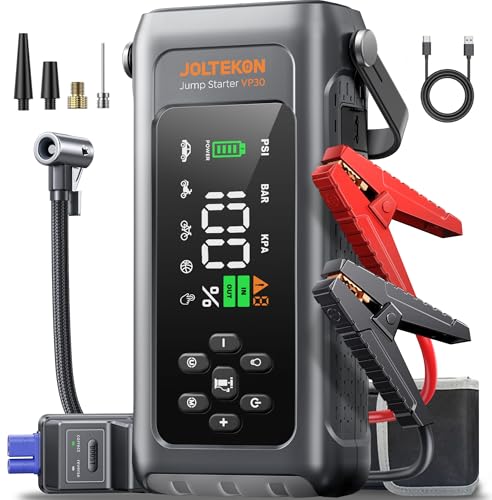
Best for: Roadside emergencies and family vehicles
The JOLTEKON is a 12V jump starter, tire inflator, power bank, and emergency light in one unit. Its 4,500A rating is designed for vehicles up to 9L gas or 8L diesel, including cars, trucks, motorcycles, boats, and lawnmowers. A force-start mode is available for low-voltage batteries, but the clamps must be connected correctly and the car should be started within 30 seconds.
The built-in compressor reaches 150 PSI and includes five inflation modes, four nozzles, three pressure units, and automatic shutoff. The product claims it can bring a tire to 25 PSI in a few minutes, though results depend on tire size and starting pressure. A 500-lumen light offers flashlight, SOS, and strobe modes. The 3.3-inch display shows remaining power, while USB-C output can charge phones and tablets. Around $100, it costs more than a basic booster, but combines several roadside tools. Its shell is rated for rain, dust, and drops, and the battery uses V0-rated fire-resistant materials.
Pros
- Combines jump starting, tire inflation, USB-C charging, and emergency lighting.
- Automatic compressor shutoff helps reduce over-inflation risk.
- 3.3-inch display and 500-lumen light improve roadside visibility.
Cons
- It needs a full charge before first use and recharging every two to three months during storage.
- The 30-second start window and 50% minimum charge requirement may complicate emergencies when preparation was missed.
Buying Guide
The most important factor is verified starting power, matched to your engine size. A compact unit rated around 1,000 to 1,500 peak amps offers more useful reserve than one with a large claim but no engine guidance.
- Engine compatibility: Choose a model that lists your vehicle type and engine size. Aim for at least 600 peak amps for a four-cylinder gasoline car, 1,000 amps for a V6 or small diesel, and 1,500 amps for larger trucks.
- Battery capacity: Look for 10,000 to 20,000mAh, though capacity claims vary. That range usually provides several starts per charge, while 5,000mAh units leave less reserve.
- Safety protection: Require reverse-polarity, short-circuit, overcharge, and over-temperature protection. Clear red and green clamp lights can reduce connection mistakes in dark conditions.
- Cable and clamp reach: Clamps with 12- to 18-inch leads fit many battery layouts. Choose insulated jaws and flexible cables for cold-weather use.
- Price and upkeep: A sensible budget is $50 to $100. Recharge the pack every three to six months, and choose USB-C input for easier charging.
If you cannot have everything, prioritize verified engine compatibility and starting-current output over extra ports or lights.
Frequently Asked Questions
How powerful should a budget car jump starter be?
Choose a model rated at least 1,000 peak amps for most four-cylinder gas cars, but check your vehicle’s manual first. A 1,500-amp unit offers more margin for larger engines and cold weather. Peak amperage alone does not show battery quality, so also check the clamp design and 12-volt output.
What features matter in an affordable jump starter?
The key features are sufficient starting power, reverse-polarity protection, solid clamps, a USB output, and a readable charge indicator. For a low-cost unit, look for cables around 12 to 18 inches long and a battery gauge with at least four levels. A built-in light can help during roadside repairs.
Can a cheap jump starter start a dead car battery?
Yes, a budget jump starter can start a dead 12-volt car battery when its rating matches the engine and the pack has enough charge. Many compact models suit four-cylinder engines, while larger vehicles may need 1,500 peak amps or more. Follow the connection order printed on the clamps.
Are inexpensive portable jump starters safe to use?
Yes, inexpensive portable jump starters are safe when they include reverse-polarity, short-circuit, and overcharge protection. Inspect the clamps and cables before each use, then keep the pack charged according to its manual. Recharge it every 3 to 6 months if it stays stored in your trunk.
Conclusion
The JOLTEKON Car Battery Jump Starter with Air Compressor is the top pick for drivers who want one compact emergency tool for routine roadside problems. If your priority is starting large trucks, diesel engines, or several vehicles between charges, choose a higher-output jump pack with a larger battery instead. Before buying, double-check the unit’s size, compatibility with your vehicle and engine, included quantity of cables or accessories, and current price. A built-in compressor adds useful backup for low tires, but it can make the case heavier and slower to store in a small trunk. Keep the charger charged, inspect the clamps and cables, and follow the maker’s instructions when connecting it to the battery.