
For most buyers, the MaxxHaul 50947 Stackable Vehicle Car Ramp is the top pick among the best car ramps because its stackable design makes storage and setup easier. This pair suits routine vehicle work, including oil changes, inspections, and underbody access, without taking up the space of fixed steel ramps. Its molded construction keeps the design simple, but buyers should confirm the weight rating and clearance for their vehicle before ordering.
This guide is for DIY vehicle owners who need safer access beneath a car, truck, or SUV. The key factors are ramp height, weight capacity, overall size, material strength, and tread grip. Storage space also matters if the ramps will live in a garage or shed. The five picks below are ranked with clear reasons and honest drawbacks for each, so you can choose a suitable lift for your vehicle and workspace.
Quick Comparison
| # | Product | Best For | Price | |
|---|---|---|---|---|
| 1 | MaxxHaul 50947 Stackable Vehicle Car Ramp | Buyers needing stackable vehicle ramps | ~$69 | View → |
| 2 | Ironton Poly Car Ramp Set | Shoppers wanting lightweight poly ramps | ~$66 | View → |
| 3 | MaxxHaul 50515 Lift Car Ramps, 2-Pack | Drivers needing two lift ramps | ~$70 | View → |
| 4 | TOWKING 16000lb Car Ramps | Owners of heavier vehicles | ~$100 | View → |
| 5 | LOCKIETTA Hydraulic Car Ramps with Jack, 2-Pack | DIYers wanting hydraulic lifting assistance | ~$160 | View → |
5 Top Car Ramp Picks
These five vehicle ramps are ranked by lift height, weight capacity, safety features, and value, counting down to the top pick.
5. LOCKIETTA Hydraulic Car Ramps with Jack, 2-Pack

Best for: Home mechanics servicing trucks and SUVs
The LOCKIETTA 2 PCS Hydraulic Car Ramp set combines two welded steel ramps with built-in hydraulic lifting. Each ramp uses a 5-ton hydraulic pump and supports the advertised total load of up to 11,065 pounds. The height adjusts from 9 to 14.3 inches, giving extra room for oil changes, exhaust work, and undercarriage repairs. At around $160, it targets buyers who need more lift than fixed plastic or metal ramps provide.
Each ramp measures 45 by 12.6 by 14.3 inches, so it can fit a home garage without taking up a full work bay. A protective coating helps resist rust, while the anti-slip tread adds traction as tires climb the platform. Automatic locks help hold the raised position, but safe setup still matters. Use both ramps on level ground, set the parking brake, and center the wheels before working underneath. The stated 24-hour support response may help with setup or usage questions.
Pros
- Two hydraulic pumps provide adjustable 9 to 14.3-inch lift.
- Welded structural steel supports vehicles up to 11,065 pounds.
- Anti-slip surfaces and automatic locks add stability during repairs.
Cons
- The 45-inch length and 12.6-inch width require a clear, level setup area.
- Hydraulic ramps need careful positioning and wheel centering, so they are less convenient than fixed drive-on ramps.
4. TOWKING 16000lb Car Ramps
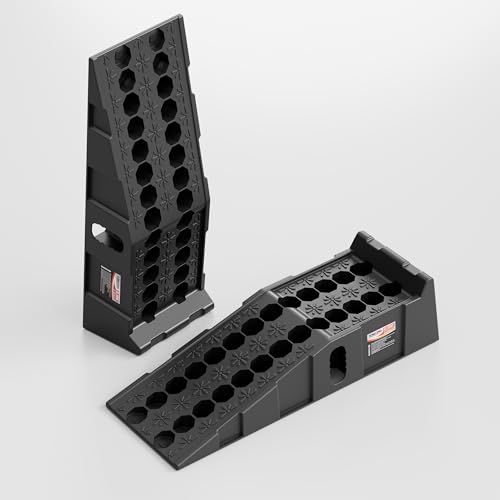
Best for: DIY oil changes on SUVs and trucks
The TOWKING 16000lb Car Ramps are a pair of plastic vehicle ramps for routine work under cars, SUVs, and trucks. They use impact-resistant polypropylene and support up to 16,000 pounds per pair. That rating applies to the combined set, so the vehicle must stay below the stated limit. At around $100, they offer a simpler option than using a floor jack and separate stands for basic oil changes or inspections.
Each ramp raises the vehicle as much as 7.1 inches. The 11.1-inch-wide path gives larger tires more room, while the 17-degree incline supports a gradual approach. A textured top surface helps tires maintain contact as the vehicle climbs. The wider parking area also gives the tires a defined stopping zone. Still, these ramps only belong on hard, flat, level pavement or concrete. Dirt, grass, gravel, and sand can reduce stability. The fixed height also limits access compared with lifting equipment that allows more clearance.
Pros
- 16,000-pound combined capacity suits many cars, SUVs, and trucks.
- Provides up to 7.1 inches of clearance for oil changes and inspections.
- An 11.1-inch path and textured surface support tire placement and grip.
Cons
- Requires hard, level ground, so it is not suitable for gravel, soil, grass, or sand.
- The fixed 7.1-inch lift may not provide enough room for larger repairs.
3. MaxxHaul 50515 Lift Car Ramps, 2-Pack

Best for: Routine under-car maintenance on cars and SUVs
The MaxxHaul 50515 is a pair of plastic drive-on ramps that raises a vehicle 6.25 inches. Each ramp supports up to 3,250 pounds, for a combined rated capacity of 6,500 pounds. That gives owners a straightforward option for oil changes, exhaust work, inspections, and other tasks beneath the chassis. The ramps cost around $70, though prices can change.
The ridged driving surface helps tires maintain contact as they climb. Rubber stops at the base also help reduce sliding on a suitable, level surface. Heavy-duty plastic keeps the pair lighter and easier to store than many metal ramps, but buyers should still confirm the vehicle’s weight and tire fit before use. This setup lifts only the driven tires, so it does not provide the access of a full vehicle lift. The fixed height may also leave limited room for larger repairs.
Pros
- Raises the vehicle 6.25 inches for basic underside access.
- Supports up to 3,250 pounds per ramp.
- Ridged plastic surfaces and rubber base stops improve tire and ramp grip.
Cons
- A 6.25-inch lift may not provide enough clearance for every repair.
- The ramps lift only two tires, limiting access compared with a full-body lift.
2. Ironton Poly Car Ramp Set

Best for: Home garages servicing trucks and SUVs
The Ironton Poly Car Ramp Set includes two ramps measuring 35.5 inches long, 12 inches wide, and 8.5 inches high. Each ramp carries up to 6,000 pounds, for a combined 12,000-pound gross vehicle weight rating. That makes the set suitable for many cars, SUVs, vans, and 3/4-ton or 1-ton pickups. At around $66, it offers a simple alternative to using a floor jack for oil changes, brake work, inspections, and tire rotations.
The main advantage is the high-impact poly construction. The pair weighs 20.6 pounds, so moving and storing them should take less effort than handling steel ramps. Poly also resists rust. A honeycomb interior adds structural support without making the ramps excessively heavy. The treaded surface helps tires climb without spinning, while rubber feet help limit movement on the ground. Still, safe use depends on placing both ramps on a firm, level surface and aligning the tires carefully.
Pros
- The 12,000-pound pair rating suits cars, vans, SUVs, and many full-size trucks.
- Poly construction weighs only 20.6 pounds per pair and will not rust like steel.
- The 35.5-inch length creates a gradual approach for many low-clearance vehicles.
Cons
- The 8.5-inch lift may not provide enough room for larger repairs or some undercarriage work.
- A 12-inch ramp width may be restrictive for vehicles with unusually wide tires.
1. MaxxHaul 50947 Stackable Vehicle Car Ramp

Best for: DIY oil changes and under-car access
The MaxxHaul 50947 is a two-piece vehicle ramp set for lifting cars and light trucks. Each ramp supports up to 3,250 pounds, for a combined capacity of 6,500 pounds. The ramps use rugged polypropylene and measure 35.63 inches long, 12 inches wide, and 8.5 inches high. They provide a 6.7-inch lift, which can create useful room for oil changes, inspections, and other basic maintenance.
Its stackable design makes storage easier than with bulky one-piece ramps. Built-in side handles also help with carrying and positioning. A ribbed platform gives the tires more grip than a smooth surface would. At around $69, this two-pack offers a practical option for home garages that need occasional vehicle access. Still, the lift height and plastic construction place limits on the jobs these ramps can handle. They are better suited to routine maintenance than major repairs requiring extensive clearance.
Pros
- Two ramps support up to 6,500 pounds together, with a 3,250-pound rating per ramp.
- Ribbed platforms provide added tire traction during use.
- Stackable construction and side handles simplify storage and transport.
Cons
- The 6.7-inch lift may not provide enough clearance for larger repairs or every vehicle.
- Polypropylene is lighter than steel, but buyers wanting maximum impact resistance may prefer metal ramps.
Buying Guide
The most important factor is the ramp’s rated weight capacity. It must support your vehicle’s total weight, with extra margin for passengers, cargo, and uneven loading.
- Weight capacity: Choose a pair rated for at least 1.5 times your vehicle’s curb weight. A 4,000-pound vehicle needs ramps rated for 6,000 pounds or more per pair.
- Lift height: Check the maximum rise before buying. Ramps that lift 6 to 8 inches suit oil changes, while 10 to 12 inches provide more room for larger repairs.
- Tire fit and approach angle: Measure your tire width and choose ramps at least 2 inches wider. A gradual 10- to 17-degree incline can reduce bumper or underbody scraping.
- Construction and traction: Steel ramps handle heavy loads but weigh more. Reinforced plastic models can weigh under 20 pounds per pair. Look for raised traction ribs, wheel stops, and non-slip feet.
- Storage and use conditions: Foldable or stackable designs save space in a garage. For outdoor work, choose ramps with rust-resistant coatings and a base that stays stable on concrete or asphalt.
If you cannot prioritize everything, choose the highest verified weight rating first, then confirm the ramp height and tire fit.
Frequently Asked Questions
How do I choose the safest car ramps?
The safest car ramps are wide, weight-rated models with a non-slip surface, a gradual incline, and a stop at the top. Choose a pair rated above your vehicle’s total weight, and check that rating includes the load on both ramps. For example, a 6,000-pound combined rating gives more margin for a 4,000-pound car than a 4,000-pound rating.
What size ramps do I need for my car?
You need ramps whose width fits your tires, whose height provides enough clearance, and whose rating exceeds your vehicle’s weight. For example, ramps about 8 to 10 inches wide and 6 to 12 inches high may fit common cars, but measure your tires and clearance first. That check takes only a few minutes.
Can I use vehicle ramps for an SUV?
Yes, you can use ramps for an SUV if each ramp’s capacity, width, length, and height suit that vehicle. For example, a 5,000-pound SUV needs a pair rated for at least 5,000 pounds combined, with each ramp supporting its share. Place them on level, solid ground and use the parking brake.
Are plastic car ramps safe for regular maintenance?
Yes, heavy-duty plastic ramps can be suitable for many cars, but they need a clear weight rating, stable base, and traction surface. A pair rated for 12,000 pounds may suit heavier vehicles, while lightweight plastic blocks intended for 2,000 pounds may not provide the same margin. Inspect them for cracks before every use and replace damaged pieces.
Conclusion
MaxxHaul 50947 Stackable Vehicle Car Ramp is the top choice for DIY drivers who need compact storage and straightforward vehicle access. If your priority is maximum capacity rather than easy storage, pick a wider, higher-capacity model instead, since it better suits large trucks or heavier equipment. Before buying, double-check each ramp’s length, width, height, and rated capacity against your vehicle, then confirm that the package includes the quantity you need and that the current price still fits your budget. Also leave room for safe wheel placement and a level surface. The right set should match your car, workspace, and maintenance plans.