
The Wireless Backup Camera is the best portable backup camera for most buyers because it sends a clear rear view to a screen without requiring a permanent wired installation. Its separate camera and monitor setup suits trailers, pickups, vans, and older vehicles that lack factory parking assistance.
This guide is for drivers who need temporary or transferable rear visibility, including people towing trailers or moving one camera between vehicles. The key factors are camera size, mounting method, battery life, wireless range, night visibility, and weather resistance. A compact design is easier to place, while a rechargeable battery can limit how long the system runs between charges. The five picks below are ranked by practical fit, with clear reasons and honest drawbacks for each. Read on to find the right backup-view system for your vehicle and parking routine.
Quick Comparison
| # | Product | Best For | Price | |
|---|---|---|---|---|
| 1 | Wireless Backup Camera | Buyers needing cordless rear visibility | ~$110 | View → |
| 2 | Wireless Solar Magnetic Backup Camera with Monitor | Drivers wanting solar-powered monitoring | ~$110 | View → |
| 3 | RV Solar Magnetic Backup Camera | RV owners avoiding permanent installation | ~$130 | View → |
| 4 | Plug-and-Play Backup Camera | DIY drivers seeking simple setup | ~$36 | View → |
| 5 | AHD Rear View Backup Camera | Users wanting sharper rear footage | ~$20 | View → |
5 Top Portable Backup Cameras
These portable backup cameras are ranked by useful features and value, counting down to the top pick.
5. AHD Rear View Backup Camera
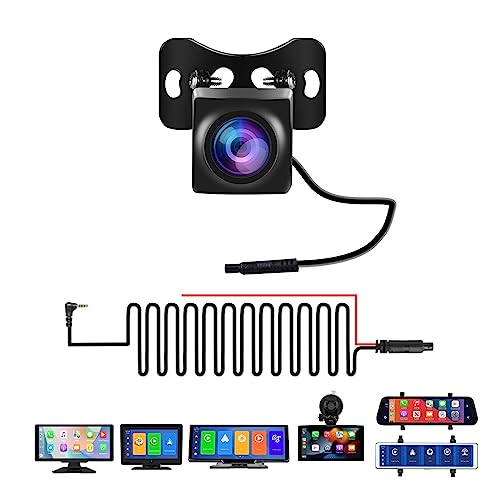
Best for: Portable-screen parking camera buyers
This square mini backup camera is made for portable CarPlay and Android Auto smart screens with a dedicated rear-camera input. It records in 1920 × 1080 resolution and uses a metal body for a compact installation. The included 15-meter extension cable gives plenty of reach for larger vehicles. It runs on DC 12V, and the price is usually around $20, making it a low-cost way to add reversing video.
The listed IP69 rating offers strong protection against dust and water, although proper installation still matters. Its wide-angle lens covers more of the area behind the vehicle than a narrow-view camera. Infrared and low-light modes support nighttime reversing, while automatic gain control, white balance, and backlight compensation help manage changing light. Compatibility is the main concern. This camera uses a 4-pin connector and only fits portable screens with a camera input. It does not suit standard head units installed in the dashboard.
Pros
- 1080P video provides a clear view for reversing and parking.
- The 15-meter cable suits many cars, vans, and larger vehicles.
- IP69 protection and infrared night vision support outdoor, nighttime use.
Cons
- It requires a compatible portable screen with a 4-pin camera port.
- The camera has no built-in parking guidelines. Lines must be enabled through the portable screen, if supported.
4. Plug-and-Play Backup Camera

Best for: DIY drivers adding basic rear visibility
This LeeKooLuu backup camera kit pairs a rear camera with a 4.3-inch LCD monitor. The included 15-foot, 3.0 mm copper cable connects the two, while power comes from a cigarette-lighter plug, manual switch, or the reversing lights. The company says installation can take about 15 minutes with the plug-and-play setup. Wiring it to the reverse lights creates an automatic rear-view display when backing up.
The camera uses an ABS+PC housing, IP69 water resistance, and a stated operating range from -22°F to 176°F. Six white LEDs support its night view, while the 150-degree lens shows a broad area behind the vehicle. The screen supports brightness, contrast, image flip, and parking-line adjustments. Its suction mount rotates 360 degrees, giving you flexible dash or windshield placement. At around $36, this is a low-cost way to add rear visibility to cars, trucks, vans, campers, and trailers. Still, the 4.3-inch display offers less viewing area than larger monitors.
Pros
- Plug-and-play wiring can reduce installation time.
- Six LEDs and an anti-halo chip support nighttime viewing.
- Adjustable parking lines and a 150-degree view help with positioning.
Cons
- The 15-foot cable may not reach comfortably on longer trucks or trailers.
- Using the cigarette-lighter plug occupies a power outlet unless you hardwire the system.
3. RV Solar Magnetic Backup Camera

Best for: RV owners needing quick camera swaps
This wireless backup camera uses a solar panel and magnetic base instead of permanent wiring. Its claimed 50-foot range helps cover long RVs, trailers, trucks, and fifth wheels. The camera includes a 5W monocrystalline solar panel and a 15,000mAh battery. A full charge takes about seven hours and provides roughly 15 to 24 hours of use, depending on night vision settings. The monitor runs from USB or a vehicle power socket.
Image features are stronger than basic trailer cameras. A CCD sensor, optical zoom, lens coating, and nine infrared lights support clearer views in low light. The monitor can switch between front and rear views, adjust parking-line width, and record looping video. Digital frequency hopping is designed to limit interference and frame delays. An IP69-rated sealed housing protects against water and fine dust, while the rubber-covered magnet helps reduce paint scratches. At around $130, it costs more than wired options, but the removable design may suit owners who use multiple vehicles.
Pros
- Magnetic mounting allows quick removal and relocation without permanent wiring.
- 15,000mAh battery supports up to 24 hours under the listed conditions.
- CCD imaging, nine infrared lights, and lens coating support clearer night views.
Cons
- The magnet needs a suitable metal surface. Aluminum, plastic, and fiberglass vehicles require a separate bracket.
- Solar charging depends on sunlight, so cloudy weather or covered storage may require USB-C charging.
2. Wireless Solar Magnetic Backup Camera with Monitor

Best for: RV owners avoiding permanent wiring
This wireless backup camera system pairs a magnetic camera with a 5-inch 1080p monitor. Its 170-degree lens covers a broad area behind an RV, trailer, truck, or camper. The camera uses a 9,600mAh battery and supports solar or adapter charging, with a claimed runtime of up to 26 hours. The monitor can sit on the dashboard or windshield.
The camera’s magnetic base attaches to steel surfaces without drilling, then removes when needed. It will not work on aluminum or other nonmagnetic panels. The signal reaches up to 180 feet, or 330 feet in open areas, according to the listed specifications. Night vision supports low-light viewing, while the IP69 rating and stated operating range of -32°F to 187°F suit outdoor use. The display supports a second camera for a two-view layout. Solar charging helps, but the product mainly relies on its power cable.
Pros
- Tool-free magnetic mounting makes temporary installation simple on steel vehicle panels.
- A 5-inch 1080p screen and 170-degree view help cover rear blind spots.
- IP69 protection, night vision, and a 9,600mAh battery support outdoor towing use.
Cons
- The camera cannot attach magnetically to aluminum trailers or other nonmagnetic surfaces.
- Solar charging may not replace wired charging, since the listed solar output is lower than power consumption.
1. Wireless Backup Camera

Best for: Trucks, trailers, and campers
This wireless backup camera pairs a 7-inch HD LCD monitor with a magnetic rear camera. Its base uses six rare-earth magnets and a soft rubber coating, so installation takes no wiring and should protect painted metal surfaces. The camera connects over a 2.4GHz digital signal with a stated range of up to 33 feet. Around $110, it costs more than basic wired cameras, but avoids routing cable through a vehicle.
A built-in 15,000mAh battery can run for up to 24 hours after a five-hour charge, while the 5W solar panel can add power during outdoor use. The camera uses a 1080P color sensor, six glass lens elements, an F1.2 aperture, and a 170-degree viewing angle. Its IP69 rating supports wet conditions, and the operating range is listed as -22°F to 176°F. A second camera can connect through the dual-channel monitor, and adjustable parking lines may help with trailers or tight spaces.
Pros
- Magnetic installation takes about one minute and avoids permanent wiring.
- Large 15,000mAh battery supports up to 24 hours of stated use.
- Dual video channels, a 170-degree view, and parking lines help cover trailer blind spots.
Cons
- The camera still needs periodic charging. Solar input may be slow in shade or poor weather.
- Magnetic mounting only works on suitable metal surfaces, and the 33-foot signal range may not fit every long trailer.
Buying Guide
Wireless signal reliability is the most important factor because a delayed or dropped image can hide a nearby obstacle. Choose a portable reversing camera with a stable connection and minimal lag.
- Signal range and delay: Look for at least 30 feet of usable range and image delay below 0.2 seconds. Digital systems usually handle interference better than basic analog models.
- Battery life and charging: Choose a camera rated for 6 to 10 hours per charge. USB-C charging is convenient, while a 12-volt adapter suits frequent vehicle use.
- Image and night vision: A 1080p sensor, 120-degree viewing angle, and infrared range of at least 20 feet provide useful coverage after dark.
- Weather resistance: Select an IP67-rated unit for rain, dust, and short-term water exposure. A magnetic or suction mount should hold firmly without blocking the license plate.
- Screen and compatibility: A 4.3- to 7-inch monitor is easier to read than a phone. Confirm that the kit works with your vehicle and does not require a separate app or subscription.
If you must compromise, prioritize connection stability and low image delay over screen size or extra mounting accessories.
Frequently Asked Questions
How do portable backup cameras work?
Portable backup cameras send a live rear view to a dash-mounted monitor or phone, helping you see behind a vehicle while reversing. Most use a wireless camera, rechargeable battery, and adhesive or magnetic mount, so installation avoids drilling. Check the viewing range, night vision, and monitor size before choosing one.
What should I look for in a portable reversing camera?
Look for clear night vision, a stable wireless connection, a wide viewing angle, and a battery that matches your driving routine. A camera rated around 120 degrees can cover much of a car’s rear area, while a 2,000 to 5,000 mAh battery may reduce frequent charging. Confirm weather resistance too.
Can portable backup cameras work on trailers?
Yes, many portable backup cameras work on trailers, campers, and other vehicles, provided the wireless range reaches the monitor and the mount stays secure. A trailer setup may need 30 to 100 feet of usable range, depending on vehicle length and obstacles. Check the camera’s weather rating before leaving it outside.
Are wireless backup cameras reliable in rain?
Yes, a wireless backup camera can remain reliable in rain when it has a suitable water-resistance rating and a sealed connection. Look for an IP65 or higher rating, then mount the unit away from direct tire spray when possible. Heavy rain, mud, weak batteries, and signal blockage can still reduce image quality.
Conclusion
Wireless Backup Camera is the top recommendation for drivers who want a flexible, portable setup without routing video cables through the vehicle, especially renters, families, and owners of multiple cars. If your priority is the lowest purchase cost and a more permanent installation, choose a wired backup camera instead, since it usually avoids battery charging but requires more setup work. Before buying, double-check the camera’s physical size, mounting method, vehicle and display compatibility, included quantity, and current price, since listings can change and some packages include one camera while others include extra monitors or accessories. A clear return policy also helps if the system does not fit your vehicle or viewing needs.