
The S ZEVZO ET03 Car Jump Starter is the best car jump starter for most buyers because its balance of starting power and compact size suits everyday emergency use. It offers a practical way to restart many 12-volt vehicles without relying on another driver or a second car.
This guide is for anyone building an emergency roadside kit, replacing an old booster pack, or preparing for winter battery problems. The key factors are peak current and battery capacity, since they affect vehicle compatibility and how many restart attempts the unit can provide. A compact case also makes storage easier in a trunk or garage. The five picks below are ranked with clear reasons and honest drawbacks for each.
Quick Comparison
| # | Product | Best For | Price | |
|---|---|---|---|---|
| 1 | S ZEVZO ET03 Car Jump Starter | Best For Emergency Glovebox Backup | ~$60 | View → |
| 2 | NOCO Boost GB40 Portable Jump Starter | Best For Compact Roadside Assistance | ~$90 | View → |
| 3 | TREKURE 8000A Car Battery Jump Starter | Best For High-Power Truck Owners | ~$60 | View → |
| 4 | WOLFBOX MV24 Portable Jump Starter | Best For Drivers Needing Tire Inflation | ~$108 | View → |
| 5 | OXILAM 6000A Portable Car Battery Jump Starter | Best For Budget-Conscious Daily Commuters | ~$60 | View → |
5 Car Jump Starters Worth Considering
This ranked list counts down from fifth place to the top pick, with power, safety features, size, and value guiding each choice.
5. OXILAM 6000A Portable Car Battery Jump Starter

Best for: Drivers wanting backup power on road trips
The OXILAM Jump Starter 6000A is a 12V lithium battery pack for cars, trucks, motorcycles, RVs, ATVs, and other vehicles. Its cables are rated for gas engines and diesel engines up to 12 liters. OXILAM says one full charge can provide up to 60 jumpstarts, though actual results will vary with vehicle size, battery condition, and temperature. It sells for around $60, with prices changing over time.
This unit also works as a portable power bank. Two USB outputs support phone, tablet, Kindle, and camera charging, while the USB-C port accepts faster input charging. A built-in LED screen shows remaining battery power, and the 800-lumen light offers flashlight, strobe, and SOS modes. The shell has a protective cover, water-resistant construction, and textured sides for a steadier grip. Ten safety protections cover concerns such as reverse polarity, short circuits, sparks, and overheating. Keep the pack above 50% before attempting a start, and recharge it every three months during storage.
Pros
- 6000A peak output supports vehicles with gas engines and diesel engines up to 12 liters.
- Dual USB outputs and USB-C charging add useful roadside power for mobile devices.
- LED display and three 800-lumen light modes help during nighttime emergencies.
Cons
- The advertised 60 jumpstarts is a maximum claim, not a guaranteed result for every vehicle or battery.
- Users must monitor charge levels and recharge the unit every three months during long-term storage.
4. WOLFBOX MV24 Portable Jump Starter

Best for: Drivers of large 12V vehicles
The WOLFBOX MV24 is a portable 12V jump starter for cars, trucks, boats, and other vehicles with gasoline or diesel engines under 10 liters. Its 88.8Wh battery and 4000A peak rating provide substantial starting power for roadside emergencies. Around $108, it costs more than basic compact boosters, but the higher capacity adds useful charging options.
A built-in LCD shows the unit’s status, so you can check its condition before connecting the clamps. The USB-C port supports 65W input and output, while a QC3.0 USB-A port charges phones, tablets, and some laptops. With the included PD65W charger, WOLFBOX says a full recharge takes about 1.3 hours. A one-touch boost mode helps with low-voltage batteries, and the flashlight includes high-beam, SOS, and strobe settings. Its operating range is listed as -4 to 140°F, and the IP64 rating helps protect against dust and water splashes.
Pros
- 4000A output supports 12V gas and diesel engines under 10 liters.
- 65W USB-C charging can power compatible laptops and tablets.
- LCD readout, one-touch boost, and three light modes aid roadside use.
Cons
- It is not intended for engines larger than 10 liters.
- IP64 protection does not make the unit waterproof, so it should stay out of heavy rain and standing water.
3. TREKURE 8000A Car Battery Jump Starter

Best for: Drivers wanting roadside backup
The TREKURE jump starter combines a battery booster, power bank, and emergency light in one portable unit. Its 8,000-amp peak output is rated for gas engines and diesel engines up to 12 liters. The included 8-AWG cables should support strong current flow. At around $60, it offers more than a basic battery jumper.
Its 26,800mAh battery can charge phones, tablets, earbuds, and drones through an 18W USB port. TREKURE claims up to 24 months of standby time and more than 1,000 recharge cycles. The built-in light reaches 800 lumens and includes steady, strobe, and SOS modes, with up to 12 hours of lighting. A handle and shell with water, dust, and shock resistance help with storage and roadside use. The safety system includes reverse-polarity, short-circuit, overheat, overvoltage, and overload protection.
Pros
- 8,000A peak output supports vehicles with gas engines and diesel engines up to 12 liters.
- 26,800mAh capacity and 18W charging add useful power-bank functions.
- 800-lumen light includes steady, strobe, and SOS settings for nighttime emergencies.
Cons
- The unit must be charged fully before use, and first-time setup requires draining it below 25% first.
- Its actual water and dust resistance level is not specified, so buyers should not assume it can handle submersion or heavy exposure.
2. NOCO Boost GB40 Portable Jump Starter
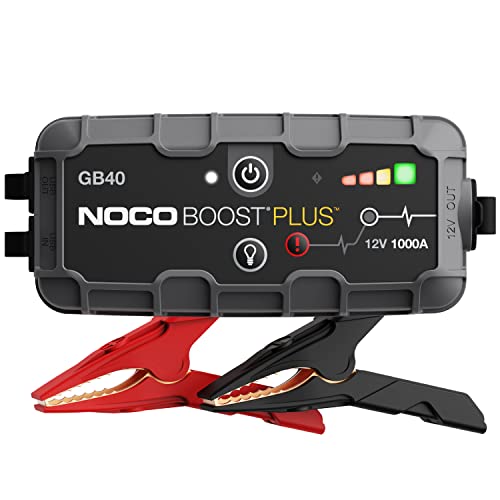
Best for: Emergency roadside battery starts
The NOCO Boost GB40 is a compact jump starter for 12V cars, trucks, and other vehicles. Its 1,000-amp lithium battery can provide up to 20 starts per charge, with stated limits of 6.0-liter gasoline engines and 3.0-liter diesel engines. At 2.5 pounds, it can fit in many glove boxes or emergency kits. The package includes the unit, heavy-duty clamps, a USB-C charging cable, and a microfiber storage bag.
Safety is a major focus. Spark-proof protection and reverse-polarity protection help reduce connection mistakes when attaching the clamps. The GB40 also works as a power bank for phones and tablets, though it needs about three hours to recharge. Its built-in 100-lumen LED has seven modes, including SOS and strobe, for roadside repairs or emergencies. An IP65-rated housing, rubber over-molding, and impact protection add durability, but the jump starter still needs regular charging before long trips. Around $90, it costs more than basic emergency battery packs, yet it combines starting power, lighting, and device charging in one small tool.
Pros
- 1,000 amps can support up to 20 starts per charge.
- Reverse-polarity and spark-proof protection make clamp connections safer.
- Seven LED modes include SOS and strobe for nighttime emergencies.
Cons
- It cannot support engines above 6.0 liters for gas or 3.0 liters for diesel.
- Around $90 is a high price for buyers who only need occasional jump starts.
1. S ZEVZO ET03 Car Jump Starter

Best for: Drivers wanting roadside battery backup
The S ZEVZO ET03 is a 12V jump starter for cars, trucks, motorcycles, lawnmowers, and boats. Its rated 4,000-amp peak current supports engines up to 8.0L gas or 7.0L diesel. The 74Wh battery can provide up to 50 jump starts per charge, though actual results depend on the vehicle and battery condition. It costs around $60, with prices changing over time.
Its force-start function can help with a battery showing 0V. The pack must be fully charged or above 14V for that task. Two 5V/2A USB ports can charge phones and tablets at the same time. A 500-lumen LED light adds steady, strobe, and SOS modes for nighttime emergencies. The LCD screen shows charge status, while the included case keeps the jump cables and USB-C charging cable together. Ten safety protections cover issues such as reverse polarity, short circuits, overcharging, surges, and sparks. It works from 14°F to 140°F and includes two years of service coverage.
Pros
- Supports large engines, up to 8.0L gas and 7.0L diesel.
- Can assist with 0V batteries when properly charged.
- Combines phone charging, an LCD display, and a 500-lumen emergency light.
Cons
- The claimed 50 jump starts will vary with battery size, temperature, and vehicle condition.
- Users must monitor charge levels carefully for 0V starts, since the unit needs a full charge or more than 14V.
Buying Guide
The most important factor is starting output, because the pack must deliver enough current to turn your engine over. Match the manufacturer’s engine-size rating to your vehicle, not just the largest peak-amp number on the box.
- Starting current: Choose at least 600–1,000 peak amps for most four- and six-cylinder gas engines. Larger engines and diesels may need 1,000–1,500 amps or more.
- Battery capacity: Look for roughly 10,000–20,000 mAh for emergency use and several starts between charges. Treat capacity as a comparison point, not a guarantee.
- Safety features: Require reverse-polarity alerts, spark-resistant clamps, short-circuit protection, and overheat protection. Audible warnings help in dark or stressful conditions.
- Size and cable reach: A unit under 2.5 pounds and about 7 by 3 by 1.5 inches fits most glove boxes. Clamps should reach battery terminals without pulling tightly.
- Charging and extras: USB-C input can recharge newer models faster. A built-in flashlight, USB output, and 12-volt port add value, but avoid paying over $150 unless you need high output or frequent use.
If you cannot have everything, prioritize a starting rating that clearly matches your engine and climate.
Frequently Asked Questions
How do car jump starters work?
A portable car jump starter sends a high-current burst to the battery, allowing the starter motor to turn the engine without another vehicle. Most models use lithium-ion cells and connect through red and black clamps. A unit rated around 1,000 peak amps may suit many four-cylinder cars, though ratings vary by brand.
What size jump starter do I need for my car?
You need a jump starter matched to your engine type and size, with extra output for diesel engines, cold climates, or larger motors. Many four-cylinder gasoline cars work with about 600 to 1,000 peak amps, while larger trucks and diesel vehicles may need 1,500 amps or more. Check the vehicle manual first.
Can a jump starter charge a dead battery?
Yes, a jump starter can provide enough power to start a car with a discharged battery, but it does not fully recharge that battery. After the engine runs, drive for at least 20 to 30 minutes or use a battery charger. A severely damaged battery may not hold a charge afterward.
Are portable jump starters safe to use?
Yes, portable jump starters are generally safe when used according to the manual and connected with correct polarity. Turn off the vehicle, attach red to positive and black to negative, then remove the clamps in reverse order. Look for reverse-polarity protection, insulated clamps, and a clear charge indicator before buying.
Conclusion
S ZEVZO ET03 Car Jump Starter is the top recommendation for drivers who want a simple roadside backup for routine car emergencies. It suits owners seeking a practical kit for home, work, or road trips. If your priority is the lightest, easiest-to-store option, pick the most compact model in the roundup instead, even if it includes fewer extras. Before buying, double-check the unit’s size, compatibility with your vehicle and engine, number of included accessories, and current price, since packages and listings can change. Keep the booster charged as directed, and store it away from high heat and moisture. A jump pack can reduce roadside stress, but safe connection steps still matter.