
The Niusken Cordless Car Buffer Polisher is our top pick for most buyers because its cordless format makes small polishing jobs easier to handle. It earns the best portable car polish spot for shoppers who want a compact tool without a power cord trailing across the driveway. This handheld buffer suits light paint correction, wax application, and quick finish work, though it is not a replacement for a heavy professional polisher.
This guide is for drivers who want to refresh dull paint at home, in a garage, or away from an outlet. For this type of car polisher, size and battery life matter most. A lighter body feels easier around mirrors and bumpers, while usable runtime helps finish a panel without a recharge. We rank the seven picks below by practical features, expected use, and value, with clear reasons and honest drawbacks for every model.
Quick Comparison
| # | Product | Best For | Price | |
|---|---|---|---|---|
| 1 | Niusken Cordless Car Buffer Polisher | Mobile DIY Detailers | ~$60 | View → |
| 2 | Protmex Cordless Car Buffer Polisher | Driveway Paint Care | ~$47 | View → |
| 3 | SPTA 12V Cordless Mini Car Polisher | Small-Area Spot Polishing | ~$90 | View → |
| 4 | SPTA Cordless Car Buffer Polisher | Garage-Based Car Maintenance | ~$70 | View → |
| 5 | cotaros Cordless Car Buffer Polisher | Cordless Weekend Detailers | ~$54 | View → |
| 6 | Meguiar’s Ultimate Polish | Hand-Applied Paint Refinement | ~$10 | View → |
| 7 | SPTA Cordless Mini Car Polisher | Compact Detail Workspaces | ~$111 | View → |
7 Top Portable Car Polishers
These compact polishers are ranked by power, portability, control, and value, counting down to the top pick.
7. SPTA Cordless Mini Car Polisher
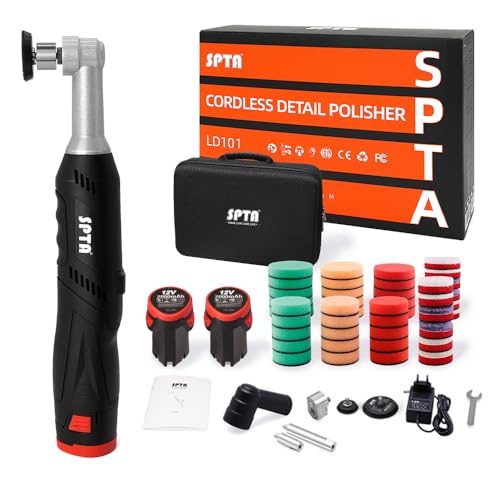
Best for: DIY detailers polishing tight body lines
The SPTA Cordless Mini Car Polisher is a compact 12V tool for small paint-correction jobs. Its 1-inch backing plate fits around emblems, body creases, door handles, and other areas that larger polishers cannot reach easily. The cordless design also removes the need for an extension cord. At around $111, it costs more than many entry-level corded polishers, but its smaller format targets a different job.
This machine uses dual-action rotation for lighter polishing work, plus a rotary attachment when you need more direct cutting power or want to use the carpet drill accessory. Its variable-speed control runs from 1,000 to 5,000 oscillations per minute. The 80W battery provides up to one hour at maximum speed, and a second battery can help reduce charging pauses. SPTA says the unit weighs over 50% less than a standard polisher, which should make detail work less tiring. Still, it is designed for spot correction, not fast polishing across large panels.
Pros
- The 1-inch backing plate reaches emblems, body lines, and narrow paint sections.
- Cordless operation lets you work away from wall outlets and extension cords.
- Variable speeds from 1,000 to 5,000 OPM suit polishing, sanding, and cleaning tasks.
Cons
- The small backing plate makes full-vehicle polishing slow.
- Up to one hour of runtime applies at maximum speed, so heavy use may require battery changes or charging breaks.
6. Meguiar’s Ultimate Polish

Best for: Dark cars needing pre-wax gloss
Meguiar’s Ultimate Polish is a pre-wax glaze for glossy painted panels. The 16-ounce bottle helps reduce the appearance of fine swirls and towel marks, then leaves the surface ready for a wax or sealant. It is safe for clear coats and other glossy paint finishes, so it suits many modern vehicles.
Its main strength is the finish it creates before the protection step. Conditioning oils add color depth and gloss, with the effect most noticeable on dark paint. You can apply it by hand for small jobs or use a dual-action polisher, including Meguiar’s MT300, across larger panels. At around $10, this polish costs little compared with professional paint correction. Still, it remains a finishing product, not a deep-scratch repair compound or long-term protectant.
Pros
- Adds richer color depth and gloss before waxing, especially on dark vehicles.
- Helps reduce the appearance of fine swirls and towel marks.
- Works by hand or with a dual-action polisher and is safe on clear coats.
Cons
- Does not repair deep scratches, heavy oxidation, or major paint defects.
- Requires a separate wax or sealant because the polish does not provide lasting protection.
5. cotaros Cordless Car Buffer Polisher

Best for: DIY car detailing at home
The cotaros Cordless Car Buffer Polisher is a battery-powered random orbital tool for waxing, polishing, cleaning, and light scratch work. Its pure copper brushed motor drives an 8mm dual-action orbit, while eight speed settings range from 2,800 to 6,300 RPM. A built-in LED shows the selected speed and remaining battery status. The cordless format makes it easier to work around a car without managing an extension cord.
Two 21V, 2,000mAh batteries come with a fast charger, so you can keep one charging while using the other. The 3-pound body has a non-slip grip, which should make panel work less tiring than using a heavier corded machine. The kit includes three flat sponge pads, three wave pads, two wool pads, two microfiber bonnets, two non-woven bonnets, and six sanding discs. That broad accessory count supports work on cars, boats, furniture, floors, marble, ceramics, and metal. At around $54, it offers a lot of included equipment, but runtime details are not provided.
Pros
- Two 21V batteries reduce interruptions during larger detailing jobs.
- Eight speeds suit gentle waxing and more demanding polishing tasks.
- The 3-pound design and 8mm orbit should be manageable for home users.
Cons
- Overheat protection may pause the tool after extended high-speed operation.
- Battery runtime and recharge time are not specified, making longer jobs harder to plan.
4. SPTA Cordless Car Buffer Polisher

Best for: DIY car waxing and light polishing
This cordless car polisher targets drivers who want to wax a vehicle without managing a power cord. Its 12V system includes two 2.0Ah lithium batteries, so one can charge while the other is in use. The motor uses copper wiring and includes anti-interference protection. SPTA lists six speed levels, from 2,500 to 5,000 RPM, for waxes, sealants, and glazes.
The 8mm random-orbit movement helps spread product evenly across painted panels. It accepts 5-inch and 6-inch backing plates, giving you a choice between tighter control and faster coverage. The kit includes three foam pads, three microfiber pads, two backing plates, towels, gloves, an apron, a storage bag, a charger, and a car lighter adapter. At around $70, the package offers useful extras for occasional home detailing, though it is not a replacement for a professional correction machine.
Pros
- Two 12V, 2.0Ah batteries reduce interruptions during longer jobs.
- Six speed settings cover gentle waxing and faster polishing.
- Cordless design and included bag make storage and transport simple.
Cons
- The listing does not provide a specific runtime or charge time.
- An 8mm orbit suits waxing and light polishing better than deep paint correction.
3. SPTA 12V Cordless Mini Car Polisher
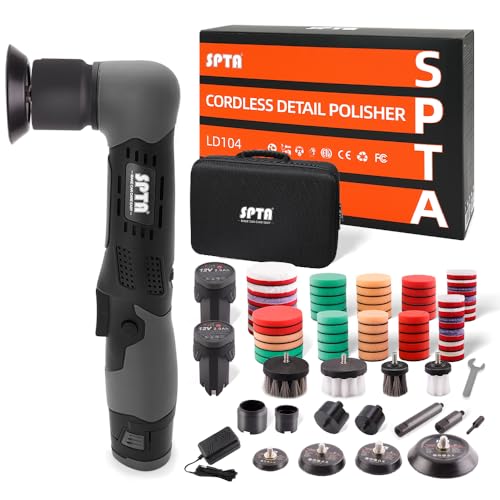
Best for: Detailers working on tight paint areas
This compact cordless polisher targets small paint-correction jobs that larger machines cannot reach easily. It includes 25mm, 50mm, and 80mm backing plate sizes for emblems, body lines, trim, and narrow panels. The kit uses two 12V, 2000mAh batteries, so one can charge while the other is in use. Its cordless design also avoids extension cords around the vehicle.
The tool offers dual-action free-spinning movement for lighter polishing work, plus a rotary attachment for more direct cutting. Speed settings range from 2,000 to 4,500 oscillations per minute. The package includes 21 polishing pads in 25mm, 21 in 50mm, and 12 in 76mm, along with four support plates, two extension shafts, two protective covers, brushes, eccentric blocks, and a storage bag. Around $90, it provides a broad accessory selection for spot correction, sanding, and cleaning. The small size helps with control, but it cannot replace a full-size polisher for large panels.
Pros
- Two 2000mAh batteries support longer work sessions without an immediate stop to recharge.
- Three backing plate sizes reach tight spaces, body creases, and small trim sections.
- The kit includes 54 polishing pads across three sizes, reducing the need for early accessory purchases.
Cons
- The small pads and compact motor make large panels slower to polish.
- Battery runtime and recharge time are not clearly specified, so buyers cannot plan sessions precisely.
2. Protmex Cordless Car Buffer Polisher

Best for: Cordless weekend car detailing
The Protmex is a cordless eccentric buffer for waxing, light paint correction, and surface finishing. It weighs 3.3 pounds with the battery attached, so it should be easier to move around a vehicle than a corded machine. Its pure copper motor has temperature protection, while the eccentric movement helps spread wax across the panel instead of concentrating it in one spot. Six speed settings cover 2,800 to 5,500 rpm, giving you lower speeds for controlled waxing and higher settings for more aggressive polishing.
The kit includes two 21V, 2,000mAh batteries, which lets one battery charge while the other is ready. Runtime is not listed, so the backup battery is useful but does not guarantee all-day work. The accessory count is generous for a buffer around $47: three standard sponge pads, three wave pads, two wool discs, two cloth covers, two non-woven covers, and six sandpapers. It can also work on wood, metal, furniture, and ceramic surfaces. Still, beginners should use care. High speeds and coarse materials can damage paint.
Pros
- Cordless design avoids a power cable around tires and panels.
- Six speeds from 2,800 to 5,500 rpm suit different polishing tasks.
- Two batteries and 18 included accessories support several surface jobs.
Cons
- Battery runtime and charging time are not specified.
- The included pads and sandpapers require careful selection to avoid paint damage.
1. Niusken Cordless Car Buffer Polisher

Best for: DIY car care without a power cord
The Niusken Cordless Car Buffer Polisher is a 5-inch dual-action machine for waxing, polishing, light scratch work, and surface cleaning. Its 8mm orbital motion uses a pure copper brushed motor and six speed settings from 2,800 to 5,800 RPM. An LED display shows the selected speed and battery level. Around $60, it offers a lot of included equipment for occasional home detailing.
Two 21V, 2,000mAh batteries and a fast charger help reduce downtime between panels. The 3.3-pound body measures 11.8 by 5 by 6.7 inches, so it should be manageable around a sedan or SUV. The kit includes 12 sponge pads in several shapes and sizes, two wool pads, two microfiber bonnets, two non-woven bonnets, and six sanding discs. The motor can shut off after more than 20 minutes at high speed to cool. That protects the tool, but it interrupts long polishing sessions. The batteries are proprietary and do not fit DeWalt tools.
Pros
- Two batteries provide a practical backup during longer detailing jobs.
- Six speeds and an LED readout offer useful control for waxing and polishing.
- The kit includes pads, bonnets, and sanding discs for several surface types.
Cons
- High-speed use may stop automatically after 20 minutes for cooling.
- The batteries are not compatible with DeWalt or other third-party systems.
Buying Guide
Most important factor is battery runtime, because a cordless polisher that stops after one panel cannot finish a full vehicle. Look for enough capacity for your car size and a charger that limits downtime.
- Battery runtime: Choose at least 30 minutes of working time per charge for a compact car, or buy a kit with two batteries. A 4.0Ah pack usually offers a better starting point than a 2.0Ah pack, though runtime varies by load.
- Pad diameter: A 3- to 5-inch pad gives better control around mirrors, pillars, and bumpers. Choose a 6-inch pad for broad doors and roofs, but expect less precision on tight curves.
- Speed control: Select variable speed with at least three settings, roughly 2,500 to 5,000 orbits per minute. Lower speeds reduce heat near edges, while higher settings remove light oxidation faster.
- Weight and grip: Keep the tool under 5 pounds with its battery. A rubber side handle and compact body reduce wrist strain during a two- to four-hour detailing session.
- Kit contents and cost: A useful starter package costs about $100 to $250 and includes two or more pads, backing plates, a charger, and a storage case.
If you must compromise, prioritize battery runtime, since power loss leaves polishing unfinished.
Frequently Asked Questions
How does a portable car polisher work?
A portable car polisher uses a small motor and rotating or orbiting pad to spread polish and remove light paint defects. Most compact models use 12-volt power or rechargeable batteries, so they suit spot repairs more than full-body correction. Choose variable speed control and a backing plate near 3 to 6 inches.
What should I look for in a portable car polisher?
Look for a portable car polisher with variable speed, a comfortable grip, secure pad attachment, and enough battery life for your intended job. A 3-inch pad works well around door handles and mirrors, while a 6-inch pad covers larger panels faster. Replacement pads should also be easy to find.
Can a small car polisher remove scratches?
Yes, a compact car polisher can remove light swirls and oxidation, but it will not fix deep scratches that catch a fingernail. Start with a mild polish and a soft foam pad, then work on a small area at low speed. Battery models may run for roughly 20 to 40 minutes.
Are portable polishers safe for beginners?
Yes, portable polishers are safe for beginners when used with light pressure, low speed, and a clean pad. Keep the tool moving instead of holding it on one spot, especially near edges and body lines. Applying too much pressure can generate heat and remove more clear coat than intended.
Conclusion
Niusken Cordless Car Buffer Polisher remains the top recommendation for car owners who want a portable, cordless tool for occasional paint polishing, light scratch work, and routine finish care without managing a power cord. It is a practical match for driveway users, apartment residents, and anyone who values storage space over professional detailing speed. If your priority is faster coverage on larger panels, choose a wider, higher-powered alternative instead, since its larger pad can reduce working time even when it adds weight or needs an outlet. Before buying, double-check the pad and tool size, battery and charger compatibility, included pad and accessory quantities, and the current price, since package contents and discounts can change.